23/04/2026
B2B Qualitative Research: Why Depth Beats Scale When the Decision Is Irreversible
Discover why B2B qualitative research delivers deeper market intelligence than quantitative data for irreversible decisions - with real case studies from PE and consulting projects.
The first question most clients ask when scoping a research project: "How many interviews do we need?"
It's the wrong question. The right one: "What do we need to understand before we can defend this decision?"
Those two questions lead to completely different research designs, and only the second one produces an answer you can defend in a partner meeting.
B2B qualitative research is built around the second question. It's the method you reach for when decisions carry consequences that can't be undone - market entry, acquisition, product strategy - and when the people who hold the real answers work in organizations that don't fill out survey panels. The explosion of generative AI in market research has created a temptation to automate this step. Automation produces patterns from existing data. It cannot call a compliance director at a Swiss hedge fund and ask why they declined a vendor last quarter. That answer lives in a conversation, not a dataset.
What B2B Qualitative Research Catches That Surveys Miss
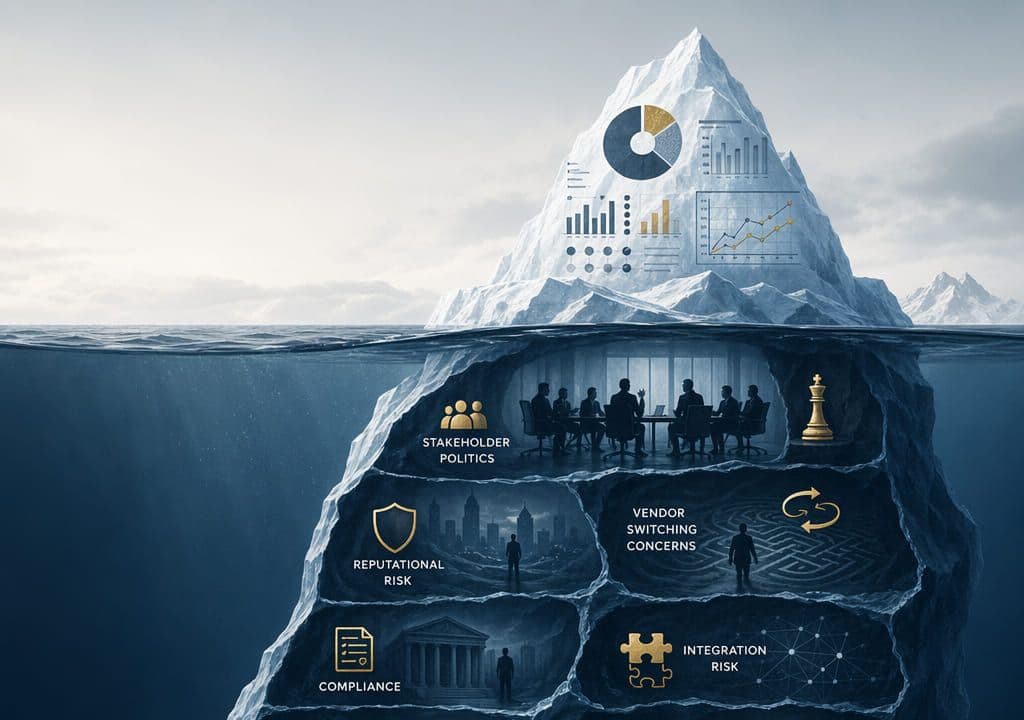
B2B buying is not a single act. The American research and advisory firm Gartner puts the average number of stakeholders in a B2B purchase at 6 to 10, each with different priorities and different veto power. A CFO evaluating total cost of ownership, a VP of IT assessing integration risk, a procurement manager following internal sourcing policy - they all sit in the same deal, and they all weigh factors differently.
What makes this harder than it looks: B2B buyers don't make decisions on numbers alone. They're also managing something surveys don't capture - their own professional reputation. A bad vendor recommendation doesn't just cost the company money; it costs the person who made the call their credibility. That pressure changes how people buy, what they say in official communications, and what they'll only admit in a private conversation. Qualitative research creates the conditions for that admission.
A well-run qualitative project cross-verifies findings across multiple stakeholder types and geographies. When the same concern surfaces among customers, channel partners, and implementation teams independently, that's a finding you can defend in a partner meeting — the core standard of decision-grade B2B research. When it appears only in one respondent profile, it's a signal worth noting but not the basis for a recommendation. The difference between those two outcomes is where research quality is decided.
That gap is decisive. In commercial due diligence, a deal thesis built on quantitative satisfaction scores can fall apart the moment qualitative B2B research surfaces that those scores reflect low expectations, not genuine loyalty. At Bell & Holmes, we've seen this pattern repeatedly: acceptable numbers hiding a fragile customer base, often because the VoC study only reached the customers management chose. The qualitative work catches it before close. For a workstream-by-workstream view of when qualitative or quantitative research should lead, see our decision framework.
How Question Framing Determines What You Actually Learn
The value of a personal account is specificity. When a Head of Compliance at a hedge fund tells you exactly why they shortlisted one vendor over another, they give you something a survey code never will: the actual reasoning behind the choice.
How the question is framed determines what you learn. For a practical open-ended question bank for commercial due diligence, see our practitioner’s template. Experienced qualitative researchers are consistent on this point: asking someone "when you purchase" rather than "when your company purchases" shifts the respondent out of institutional-policy mode and into real experience. Kvale's InterViews identified the mechanism decades ago, but any researcher who has conducted five hundred B2B conversations recognizes it instinctively. You stop receiving the official procurement framework. You start getting the actual decision. For respondents in regulated industries or large organizations, this is the difference between useful data and defensive boilerplate. The procurement policy sits in a SharePoint folder. The actual process sits in the head of whoever ran the last vendor review.
Qualitative responses also surface the language buyers use before you ever write a positioning document. They expose hidden objections and reveal how competitive switching actually unfolds inside regulated industries where procurement moves slowly and the stakes of getting it wrong are substantial. This is primary research worth paying for - genuine understanding of what drives decisions inside the organizations that matter to your deal thesis.
Bell & Holmes Case Study: Urgent Need for Targeted Outreach on a Niche Compliance Solution
A global technology consultancy needed to validate market interest and gather competitive intelligence on a specialized compliance software used by hedge funds and asset managers across Europe and North America. Five working days. Hard-to-reach C-level executives across six countries.
Expert networks were too slow and too costly for the volume required. Survey providers couldn't reach this population at all. Bell & Holmes ran direct outreach, conducting multilingual in-depth interviews across Italy, the Netherlands, France, the UK, the US, and Canada - all with C-level executives, compliance heads, and technology directors actively using comparable tools. Every interview was conducted in the respondent's native language by a native-speaking researcher. A compliance director in Milan explains vendor decisions differently in Italian than in English - and translated interviews strip exactly the detail that due diligence depends on.
The result: 23 in-depth interviews in five working days. Findings covered adoption patterns, decision rationales, perceived product weaknesses, and pricing benchmarks. The client used the output directly to shape advisory recommendations in an active due diligence process.
"Extremely responsive and flexible to changing priorities, as well as delivering really high quality insights.
Depth and quality: 5/5."
Big 3 Consultancy - UK - Senior Manager
Bell & Holmes Case Study: Identifying and Engaging a Niche User Base for a Complex Data Platform Across Global Markets
A European private equity firm needed targeted research on a high-performance enterprise data platform managing very large information volumes. Scope: only current users and current implementation partners, across North America and Europe. Timeline: three working days. Client list: none usable.
Bell & Holmes independently sourced and verified every respondent - senior decision-makers at large corporations across financial services, healthcare, and retail - before conducting 16 in-depth interviews. Findings covered adoption rationale, satisfaction drivers, competitive alternatives considered, pricing, switching behavior, and deployment models.
"The insights are super and the N higher than expected. We needed this until Friday and are very happy with such a fast turnaround within 1 day.
I am a big advocate of Bell & Holmes."
Private Equity Firm - EU - Partner
The deal team had what they needed before the week was out.

Choosing the Right B2B Qualitative Research Agency
Speed. In PE due diligence and consulting work, research windows are typically a week or less. An agency that takes three days to confirm they can start is already a liability. The right partner ramps within 24 to 48 hours and delivers first interviews the following morning.
Sourcing capability. Where do their respondents come from? If the answer is "a panel" or "our network of experts," that is a rebranded survey. Real B2B qualitative research means cold outreach to verified current market participants, conducted by people who can hold a 20-30 min strategic conversation in the relevant language. Someone who left the industry three years ago carries perspective but not currency.
Adaptability. B2B projects shift mid-flight. New hypotheses emerge, clients reallocate focus to a different segment. An agency that can't adjust the questionnaire or target profile daily will produce a clean report built on the wrong questions.
Validation methodology. Ask how the agency distinguishes signal from noise. Cross-verification across stakeholder types and geographies is the standard. A pattern that replicates independently is defensible. One that appears in a single group needs qualification.
Three Questions That Reveal an Agency's Real Capability
- Ask directly: "If the profile we've defined is hard to reach, what's your fallback?" A deflection or a generic answer tells you what you need to know.
- Ask: "Can you show me a case where you reached respondents in a highly regulated or niche industry within 72 hours?" The specific example matters. The willingness to give one matters more.
- Ask: "What percentage of your respondents are current industry participants versus former?" Former executives add context, not current intelligence.
The right qualitative research services partner explains constraints upfront, confirms what's achievable, and gives you a fixed-price offer before work starts.
The Competitive Advantage of Depth Over Scale
When the stakes are low, survey data is sufficient. When you're defending a market entry recommendation to a Fortune 500 board, or closing a $150M acquisition, sufficient is not good enough.
Generative AI has expanded what's possible with quantitative analysis at scale. What it hasn't changed is the need to understand why buyers make specific decisions in specific contexts. A model trained on historical responses cannot ask the follow-up question that changes the conclusion. A trained researcher can - which is exactly the boundary that top qualitative research agencies in 2026 are building their operating model around.
Twenty in-depth interviews with the right current market participants, conducted by researchers who know how to follow a thread, will tell you what's actually driving decisions in that segment. Not what respondents say when prompted, but what they reveal when asked the right question and given room to answer.
The firms and funds that consistently win are the ones who know the "why" before their counterparts finish counting the "how many."
Your next acquisition, market entry, or strategy recommendation depends on what you learn in the next five days. If the decision can't be reversed, the research behind it has to hold.

Bell & Holmes delivers first interviews within 48 hours, across 140+ countries and 35+ languages - verified current market participants sourced through direct outreach. The remote-first structure that makes that speed possible is not a working-from-home policy; it is the operational architecture behind the coverage.
Ready to scope a project? Send your brief to requests@bellandholmes.com.
Our services
From hypothesis to investment-ready evidence

One operating standard across all levels of depth, and no vendor change when the question gets harder
Where we operate
Traditional Surveys
Survey Intelligence
How it works →Direct Interviews
See the process →Expert Network
Not sure which approach your project needs? We will point you to the ideal one that still answers it.