06/11/2026
Financial vs Commercial Due Diligence: What Primary Research Adds That the Data Room Can't
Financial due diligence tests whether a target's numbers are real: earnings quality, net debt and working capital. Commercial due diligence tests whether the market behind those numbers will keep paying after the deal closes.
Financial and commercial due diligence run on the same deal timetable and often sit in the same data room. They answer different questions. Financial due diligence asks whether reported earnings are genuine and repeatable. Commercial due diligence asks whether the market will keep producing them. One looks backward at what has already happened. The other looks forward at what customers and competitors are likely to do.
What is the difference between financial and commercial due diligence?
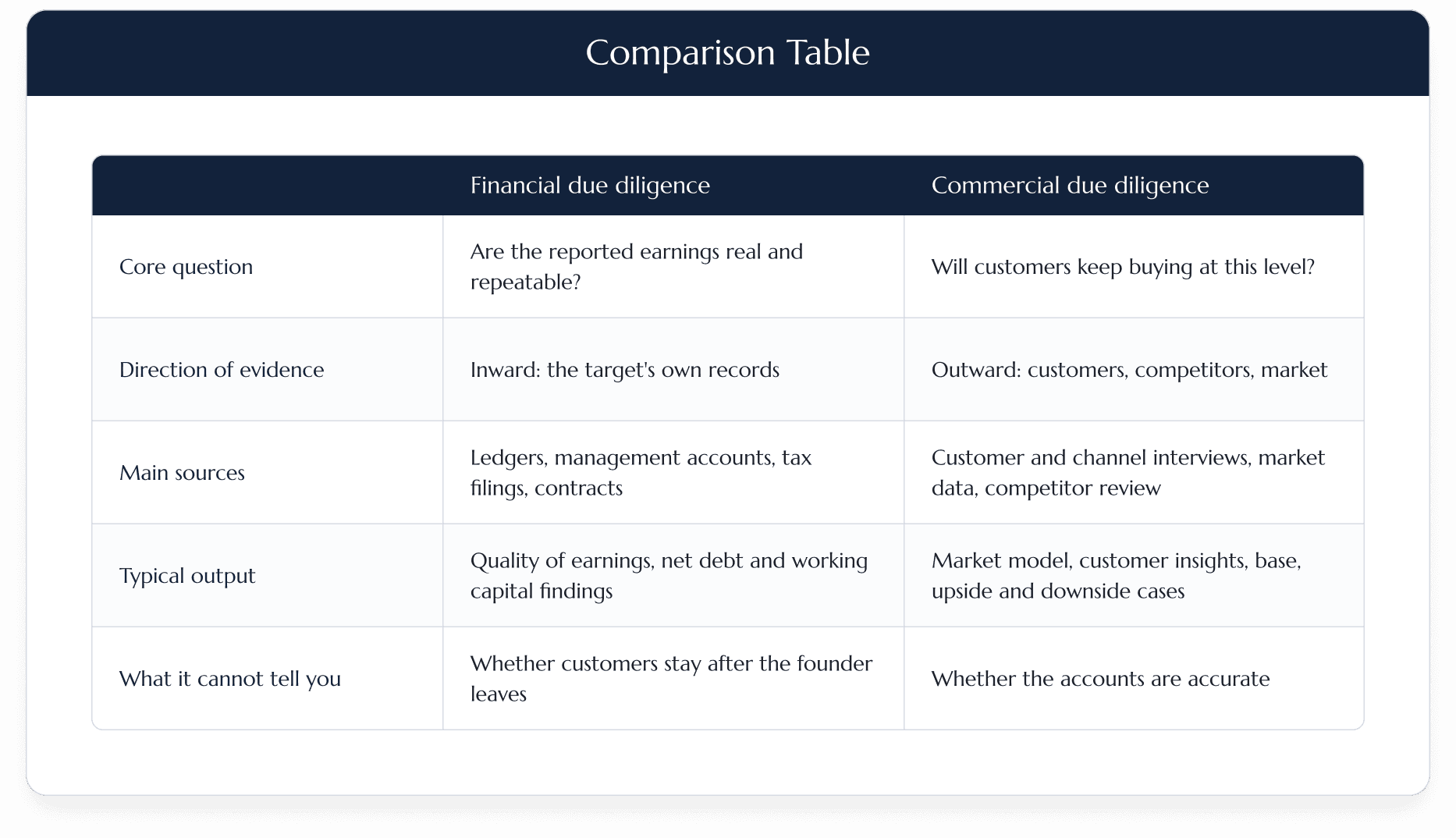
Financial due diligence asks whether reported earnings are genuine and repeatable. Commercial due diligence asks whether the market will keep producing them. The first is backward-looking forensic work on what has already happened. The second is forward-looking research into what customers and competitors will do next.
ICAEW's Corporate Finance Faculty puts it this way: commercial due diligence is "an objective enquiry to critique and challenge commercial matters relating to a business, including its business plan and financial projections."
Where financial due diligence ends
Financial due diligence can flag customer concentration and falling revenue in the company's records. It cannot show why a customer stays, what it would switch to, or whether it will renew under new ownership.
It rebuilds reported profit into the earnings a new owner would inherit, a process usually called quality of earnings. It strips out one-off items, charges a market salary for work the owner does unpaid, and restates related-party rent to market rates. It tests whether receivables can be collected and whether obligations have been fully disclosed.
Clean accounts say nothing about whether a contract renews next year, whether a competitor is quietly winning the customers the price assumes, or whether the seller's growth plan holds up. Strong growth does not settle those questions either. A fast-growing market can hide personal costs run through the company, and a clean ledger can sit on top of a customer base that belongs to one person.
Where commercial due diligence starts, and what primary research adds
Commercial due diligence begins where the data room ends. It sizes the market the company actually sells into, maps the competitors, including the ones the seller left out, and tests whether customers are loyal to the business or to one person.
The failure usually looks like this. The buyer commissions thorough financial work, the earnings hold up, and then the largest customer does not renew. That customer had dealt with the founder for a decade. Nothing in the accounts would have flagged it. Assetica, a Dubai valuation firm, describes the customer conversation as the part owners find most uncomfortable, and the part most likely to change a buyer's mind.
Secondary sources describe a market as other people have measured it. Published reports and company filings are useful, but they cannot tell you why a customer stays, what they would switch to, or what they expect to pay next year. Binocs, an AI diligence vendor, makes the same argument from a different angle: management's account of why customers stay is a hypothesis, not evidence.
Three questions test the customer side of any forecast. Will the largest customers still buy once the founder has gone? What would they switch to if they left? What will they pay next year?
Interview answers feed straight into the model. Renewal rates, price increase assumptions and the downside case all depend on what customers say. As an illustrative example, if several buyers at a top customer tell interviewers they are testing alternatives, the base case should lower that customer's renewal assumption. The buyer can then reprice the deal or agree an earn-out tied to renewal.
Calls the seller arranges give you the customers the seller chooses. Independent interviews, where the researcher chooses who to call and writes the questions, test a sample the seller did not choose.
A forecast that depends on customers renewing belongs to commercial work, even when it sits inside the financial model. Ask who is answering that question before you sign off a scope.
The stakes are not theoretical. Bain & Company's 2020 Global Corporate M&A Report says almost 60% of surveyed executives attributed deal failure to poor due diligence that did not identify critical issues. Bain does not split that figure between financial and commercial work, so it should not be read as a commercial-only failure rate.
Which one does your deal need?
The shape of the deal usually decides it. An established, profitable business bought at a multiple of historic earnings, on a continuity thesis, needs financial diligence first. A price that rests on a forecast, a new segment or a growing market needs both.
Where customer concentration is high, and a handful of customers carry the revenue, commercial work stops being optional at any deal size. Two other parties commission it. Lenders commission it to underwrite debt, and sellers commission vendor due diligence, including the commercial work, before a process starts so they can answer the buyer's questions first, according to Binocs.
Smaller deals are the exception. When the target is small and the consideration modest, a full commercial study can cost more than the risk it covers, and a focused set of customer reference calls, run properly, captures much of the benefit. Scope should follow the risk. Binocs makes the point that a commercial review which only confirms the thesis the buyer walked in with has cost the buyer money, so a cheaper route still needs a discussion guide designed to test the thesis.
Timing matters as much as scope. Where both workstreams are commissioned, commercial work often starts early, because a negative finding ends the deal before forensic costs are spent. There is little sense paying for forensic accounting on a business you will not buy.
What a commercial due diligence report contains
A commercial report is built around a short list of questions. Binocs frames the core as four: whether the market is attractive for reasons that will last, whether the company holds a position competitors cannot easily take, whether the customer economics are genuine, and what would have to be true for the growth plan to work. Everything else in the report supports those four.
The typical deliverables are findings and their investment implications, a market model with segment sizing, a customer insights summary, base, upside and downside cases tied to named drivers, and a value creation plan. Binocs notes that lenders underwrite the downside case and the investment committee votes on it.

How Bell & Holmes runs the commercial side
Our work reaches current market participants by phone. Expert networks often supply former employees and people formerly in the industry. We interview current practitioners, including in sectors such as government where expert networks may not reach.
We source the people ourselves, conduct the calls and deliver transcribed results. That is a different model from a survey provider, which delivers volume without the conversation, and from an expert network, which delivers conversation without the volume.
Three facts decide whether this fits a live deal. First interviews can arrive within 48 hours of an enquiry. Output runs from 5 to 50 interviews a day, depending on scope. And our team of more than 100 interviewers covers over 35 languages across 140-plus countries, so a multi-country target can be interviewed in each market's own language.
The trade-off is real. For a small target with a modest price, a handful of customer reference calls may be enough, and a managed interview programme is more than that deal needs. Wide-reach primary research earns its fee when the forecast depends on customers you cannot reach through the seller, and when the timetable leaves no room for a recruitment cycle.

Proof from live deals
Primary research at volume can mean 23 interviews in five working days for one client, or about 400 interviews in 12 working days for another. Neither was a financial due diligence job.
In the first, a European consulting firm needed to know whether demand existed for a niche compliance platform used by hedge funds and asset managers. We ran 23 interviews with C-level executives and heads of compliance, operations and technology across Italy, the Netherlands, France, the UK, the US and Canada. We completed them in five working days, with daily check-ins to refocus the questions as themes emerged. The client used the findings to validate assumptions in an ongoing due diligence process. Compliance platform demand study
In the second, a Big 3 consultancy needed a view of accounting software adoption across the US, Canada and several European markets, with two client offices coordinating. We ran four internal teams on daily outreach and handled a questionnaire whose priorities changed during fieldwork. We completed about 400 interviews in 12 working days, averaging 30 to 40 a day. The client's partner wrote afterwards that they would work with us again if the target market reopened. Accounting software adoption study, North America and Europe
Find out who the forecast depends on before you sign
A deal can pass financial diligence cleanly and still fail on its customers. If your next acquisition depends on a forecast, find out which customers sit behind it while there is still time to change the price or the terms. Bell & Holmes runs commercial primary research for private equity and consulting teams. Discuss a commercial due diligence scope
Our services
From hypothesis to investment-ready evidence

One operating standard across all levels of depth, and no vendor change when the question gets harder
Where we operate
Traditional Surveys
Survey Intelligence
How it works →Direct Interviews
See the process →Expert Network
Not sure which approach your project needs? We will point you to the ideal one that still answers it.