23/09/2026
Market Assessment Analysis: A Framework for Deal Teams With 10 Working Days
Market assessment analysis for deal teams: five core components, a ten-working-day timeline, and what to cut when the IC date cannot move.
Guides to market assessment analysis all cover the contents. The timeline is the part nearly every one of them skips.
That gap is no coincidence. Duration is the awkward question: the honest answer hinges on how fast you can reach the people who genuinely know the market. Choosing a framework is easy. Fieldwork is not.
If a scope has ever been agreed on a Thursday with the investment committee convening the Friday week after, the real constraint is already familiar - and it is not analytical. Porter's Five Forces fits in an afternoon. What no afternoon can hold is tracking down 40 buyers of a niche compliance product across six countries and getting them to speak candidly about why they switched vendors.
The pages ahead cover what goes into a market assessment analysis, how it differs from market research, and what a ten-day cycle actually looks like when the deadline is real. Every number comes from Bell & Holmes projects with documented durations and interview counts.
One boundary first. Bell & Holmes provides the primary research layer inside market assessments; the full strategic synthesis typically sits with the deal team or the consultancy, and we do not claim it. What we can show is the fieldwork block's cost in days - the part of the timeline that gets underestimated everywhere.
What is a market assessment analysis?
A market assessment analysis evaluates, in a structured way, whether a market can carry one specific commercial decision: entering it, buying into it, or launching within it. Quantitative sizing is paired with qualitative evidence about how buying decisions actually get made.
Five components appear in nearly every credible version: Market trends and drivers. Market size and growth potential. Competitive analysis. Customer segmentation. Regulatory environment.
Published guides mostly converge on roughly this set, and rightly so. The component list stops being useful at the moment you ask which components can genuinely be evidenced in the time available. A regulatory scan is desk work; understanding why a buyer chose vendor B over vendor A requires speaking to that buyer.
That divide, desk-answerable versus fieldwork-answerable, is what governs the calendar.
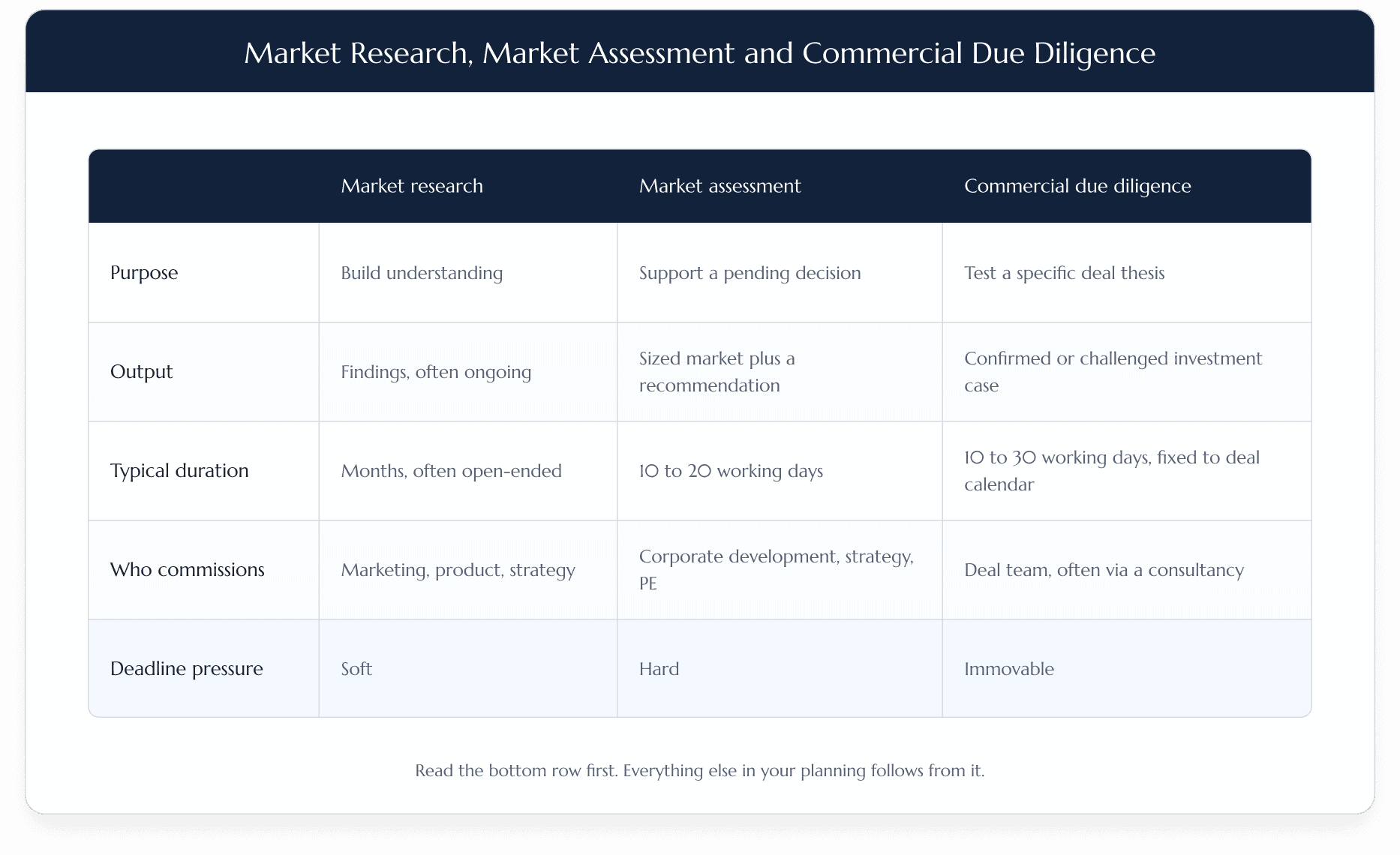
Market assessment vs market research: the distinction that sets your timeline
Market research is a method; a market assessment is a decision artefact with a deadline attached.
Research gets commissioned to learn something; an assessment gets commissioned because a specific choice is pending and somebody will be held accountable for it. That difference redefines "finished". Research finishes when its questions are answered. An assessment finishes when the committee meets, whether or not every question closed.
Commercial due diligence goes one step narrower: one target company, one seller narrative, one transaction date.
What goes into a market assessment framework
A framework's job is to organise what you already know; generating evidence is not its job. Confusing the two is the most common way a week gets lost.
Six of them get used repeatedly, and published inventories tend to list them without comment. What those inventories leave out is exactly what scoping needs: the time each framework actually costs, and whether desk sources alone can complete it.
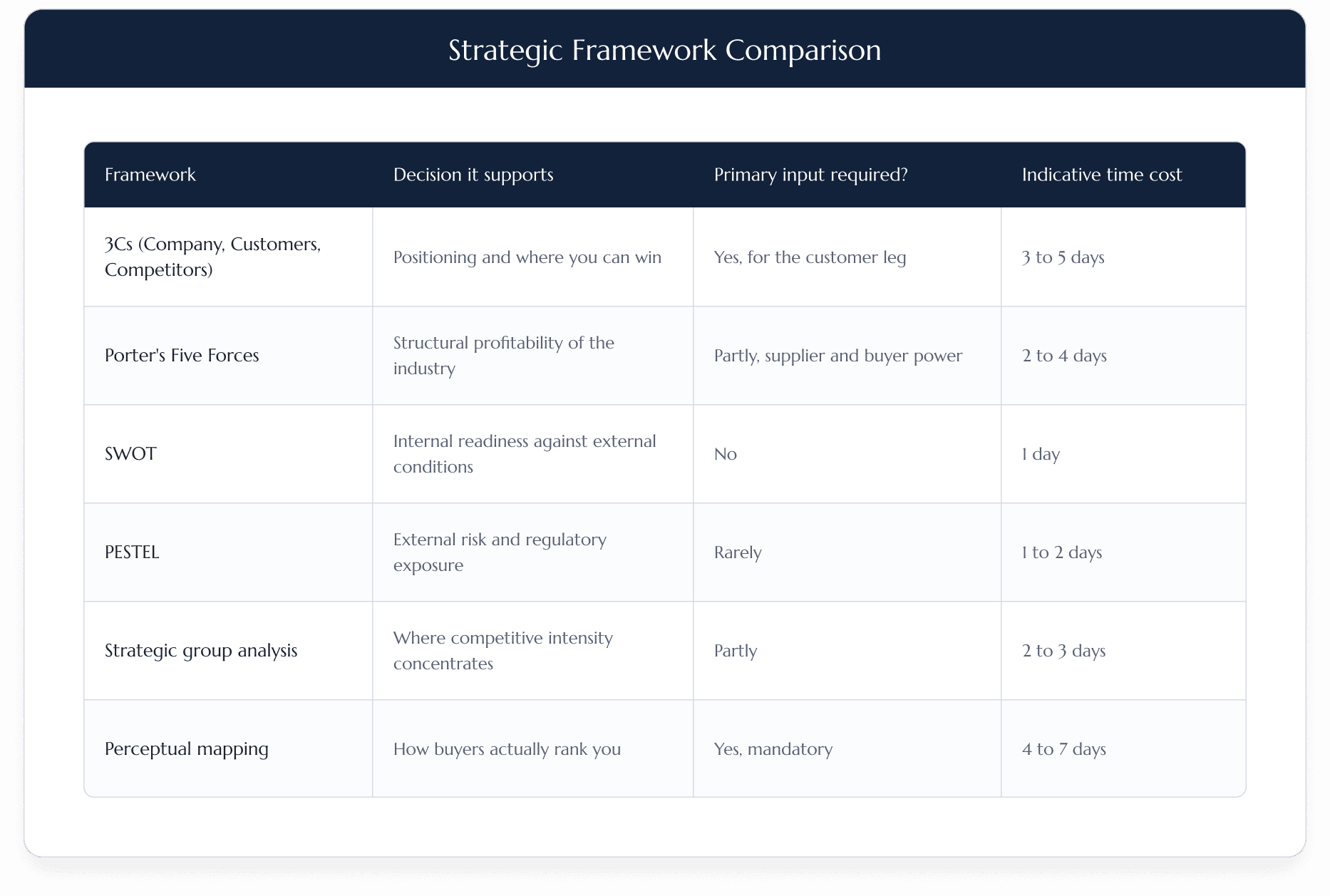
The time costs shown are Bell & Holmes scoping estimates from project experience, not published standards. Treat them as planning inputs to argue with, not as benchmarks.
Two entries on the list, perceptual mapping and the customer leg of the 3Cs, cannot be honestly completed without talking to people - they set the critical path, while everything else runs in parallel once fieldwork is live.
How long does a market assessment take?
Deal-driven assessments mostly take 10 to 20 working days. Fieldwork accounts for nearly all of the variance; analysis accounts for almost none.
Four things move the number: how many geographies are needed, how many languages that implies, and how senior the respondents must be.
The fourth is whether syndicated data exists at all - building a market from nothing is slower than validating one somebody else already sized.
A single-geography assessment with mid-level respondents and an existing industry report closes in 10 working days. Multi-country work with C-suite respondents in markets nobody covers takes 20, with the extra time going to sourcing rather than interviewing.
Anyone quoting a fixed duration without asking those four questions is quoting a template, not a plan.
The 10-day market assessment, day by day
10 working days works, and heroics have nothing to do with it: fieldwork throughput runs higher than most scoping assumes, and findings arrive daily instead of at the end.
The eleven published Bell & Holmes project write-ups show fieldwork blocks of three to seven working days, with interview counts from 16 to 105 inside those blocks. Durations like those are what let the rest of the calendar fit.
Before planning the 10 days, decide whether 10 is the right target at all. A US public-sector assessment of county-level financial software took an initial two-week phase plus a one-week extension for additional depth – 20 working days, 300-plus qualified interviews, counties of varying sizes. That was never a 10-day scope; compressing it would have meant fewer counties or a bigger team, because interview depth is the one variable that should never absorb the squeeze.
Here is the distribution when the scope fits the 10 days.
- Before day one: scoping and offer. A 20-minute call frames the commercial question and the audience; feasibility gets confirmed against what is realistically reachable rather than what would be ideal, and a fixed-price offer comes back within two hours. This is the conversation where a 20-day scope gets identified as a 20-day scope.
- Day 1: kick-off and first outreach. A briefing call of roughly 30 minutes aligns objectives, refines the questionnaire against the reachable audience, and confirms geography and target profile. Sourcing starts immediately after the brief - there is no separate desk-research phase holding fieldwork back, because the sizing skeleton and the interview programme run in parallel from the same morning. Typical ramp-up from agreed scope to live outreach is 12 to 24 hours.
- Days 2-9: interviews and daily results. First validated findings land within 24 hours of kick-off, and from there the engagement produces output every day: a running Excel file containing every completed interview to date, daily tabulated results in whatever format the case team works in, and a 15-30 minute touchpoint to review what came back. Throughput runs from 5 - 50 interviews per day depending on how accessible the targets are, how large the team is and how wide the geography spread runs. That daily cadence turns gap-filling into a continuous activity rather than a phase. Patterns and holes surface together, usually by the third or fourth day; callbacks to earlier participants get scheduled as soon as a gap is visible, not held for a synthesis window. Question priorities, target profile, geographies and team size all adjust inside those daily touchpoints.
- Day 10: wrap-up. Final consolidation, not first assembly: the complete set of interview findings is already in your hands; what closes on day 10 is the reconciliation between sizing and interview evidence, and the explicit flagging of where the two disagree. Disagreements get stated, never smoothed over.
The distinction matters at scoping time. A linear research project delivers nothing until the end, so a slipped deadline delivers nothing at all. Under daily delivery, a case team that loses two days at the back end still has eight days of evidence to work with. That is the practical argument for the structure, and it is worth pressing any research partner on before signing.
Ramp-up speed is what makes day one already the actual interview start. A European private equity client needed conversations with users of a specific enterprise data platform across North America and Europe; the team was live within a day and delivered 16 interviews in three working days. On a US shipping marketplace study, fieldwork began on one day's notice and passed 100 interviews inside six working days.
Throughput of that kind depends on how respondents get found, and approaches diverge sharply here. An expert network offers whoever is already enrolled in it, which works well when your target population happens to be well represented on the roster and fails quietly when it is not. Active sourcing runs the other way: start from the target specification, then build the contact pool against it. The difference shows the moment a client list collapses - common enough to plan for, and covered further down.

How to run a market assessment for an acquisition
When there is a target, three things change.
First, the market is no longer assessed in the abstract: you are testing a seller's account of it, and the seller has had months to prepare theirs. Second, the questions sharpen - not "how big is this market" but "is the target's share of it durable". Third, the respondent mix shifts: current customers matter, churned customers matter more, and competitors' customers matter most, because they tell you what the target is losing on.
CB Insights analysed 431 venture-backed companies that shut down from 2023 onward and identified failure reasons for 385 of them. Poor product-market fit was cited in 43% of cases, bad timing in 29%. Running out of capital topped the list at 70%, but as the CB Insights team notes, that is the final cause of death rather than the root problem.
Read that as a diligence warning: the failure modes that kill companies are demand-side, and demand-side evidence does not live in a data room.
Market entry work inverts the same logic without changing the method. With no seller narrative to test, the market opportunity assessment has to establish demand nobody has yet claimed exists - which puts more weight on buyer conversations, not less. A corporate strategy team validating entry into two unfamiliar territories needs the same in-language buyer evidence a deal team needs, on the same clock, minus the target company.
Bain's 2026 M&A Report surveyed more than 300 M&A practitioners globally and recorded 2025 as the second-highest year on record for deal value. More competition for assets compresses diligence windows; it does not extend them.
Sizing a market when no report exists
Build it from the bottom up, with verified buyer behavior as the base unit, then triangulate against supply-side and channel evidence.
Most guides name this as the hard case and stop at the same answer: commission custom work with well-vetted experts. Correct as far as it goes - it skips the operational question of how those people get found when no list exists.
A European consulting firm needed the food supplement and OTC landscape in Romania and Serbia: pricing, marketing, consumer preferences, sales channels, regulatory direction. Public data was thin and qualified stakeholders were hard to reach. Bell & Holmes completed 31 interviews across both countries in four working days using local-language outreach, with comparative input on Hungary, Moldova and Bulgaria.
Two things often treated as equivalent are worth separating. Local-language outreach is not a translated interview guide: a guide rendered into Romanian and administered by an English-speaking interviewer gets you through the scripted questions and loses the follow-up, which is usually where the finding actually sits. On that study, outreach and interviews ran in-language, by the same people.
Two more cases make the sourcing point. On a North American ranching study the client could not supply a workable contact list, so sourcing fell entirely to the research team; 31 interviews closed in five working days. On a US trucking project targeting owner-operators, the initial client data proved unusable and the team pivoted to independent sourcing, delivering 105 interviews in seven working days.
Bottom-up sizing is not the elegant method; it is the one that survives a challenge from someone who knows the sector.
What you cut when the IC date won't move
Scope, not rigour. That distinction is the whole discipline.
Cut geographies before cutting sample depth within a geography. Three countries understood properly beats seven understood partially, and a committee will spot the difference immediately.
Cut respondent breadth before cutting respondent seniority. 20 conversations with people who actually sign the contract are worth more than sixty with users who influence nothing.
Add capacity before cutting either. Team size is a variable in the same way scope is, and a wider geography or a larger target universe is often a staffing question rather than a calendar question. It is not free, and past a point more interviewers competing for the same narrow universe stops helping - but it belongs in the conversation before depth gets sacrificed.
Cut nice-to-have themes early and explicitly; scope drift is the real timeline killer. On the accounting software project, question priorities were updated repeatedly through the engagement, which worked only because the changes were agreed in daily touchpoints rather than absorbed silently.
What should never be cut: verifying that respondents are who they claim to be, and reporting where the evidence thinned out. A purchased panel hands you a finished sample along with somebody else's verification record; active sourcing means your team found each respondent and can say how. That is slower, and it is the reason the answer survives a challenge from the one person in the room who knows the sector.
An assessment that hides its own gaps is worse than no assessment, because it converts a known risk into an unknown one.
Where compressed assessments fail
Four failure modes recur, and three of them are visible in week one if you look.
The contact list arrives unworkable. Two published Bell & Holmes project write-ups record exactly this: on the trucking study the client data proved unusable, and on the ranching study no functional list existed at all. In both, sourcing moved to the research team and the target interview counts still landed. The cost of this failure is rarely the list itself - it is the days lost before anyone admits the list is dead.
The instrument was not built for cold outreach. On a study of software usage across US fire departments, the questionnaire had to be restructured mid-project for flow and clarity in a cold-calling context; roughly 60 interviews still closed in six working days. A guide designed for a warm, scheduled call will underperform badly when the first ninety seconds are unearned.
The contact pool depletes. High-penetration work in a single geography eventually exhausts its own universe; on the county financial software project the pool narrowed as the engagement ran, and targeting had to be adjusted by county size and engagement level to keep volume up.
Inference gets stretched across borders. Assuming one market's buying behaviour transfers to the next is the quiet error. An agricultural due diligence project spanning North America, Europe and Asia required local-language capability across the US, UK, France, Spain, Italy and India to produce 30-plus interviews in five working days, precisely because regional differences were the finding and not the noise. A compliance software study across Italy, the Netherlands, France, the UK, the US and Canada produced 23 interviews in five working days on the same logic.
One caveat worth stating plainly: not every question suits a 10-day cycle. Longitudinal behaviour change, genuine attitudinal segmentation, or anything requiring a statistically representative sample of a large consumer population needs more time than this, and a compressed qualitative programme is the wrong instrument for it. If your question is "how has preference shifted over three years", plan for a different timeline.

Running this with a research partner
Most deal teams do not lack frameworks; they lack reach into a specific buyer population inside a fixed window.
Bell & Holmes runs the primary research layer: sourcing, screening, interviewing, and daily reporting into your synthesis. Coverage runs across 140-plus countries and 35-plus languages, with 100-plus research consultants available for live engagements and around 500 projects completed each year. Each respondent is found and verified by the team rather than drawn from a standing panel.
One number is worth holding on to from all of this. Bell & Holmes talks about 24 to 48 hours to first findings, and that figure describes ramp-up to first data, not the length of a finished assessment. Speed to first insight is measured in hours; a defensible assessment is measured in working days. Conflating the two is how scoping conversations go wrong.
If you want to see how the fieldwork block behaves under a real deadline before you talk to anyone, the project write-ups carry the durations and interview counts.
The choice a market assessment ultimately serves is binary: winning the asset, or walking away from it with your capital intact. Both outcomes are acceptable; discovering which one you should have picked six months after close is not.
Our services
From hypothesis to investment-ready evidence

One operating standard across all levels of depth, and no vendor change when the question gets harder
Where we operate
Traditional Surveys
Survey Intelligence
How it works →Direct Interviews
See the process →Expert Network
Not sure which approach your project needs? We will point you to the ideal one that still answers it.