28/10/2026
AI in Market Research: Where It Works, Where It Fails, and What Still Needs a Human
Six fieldwork tasks a human researcher still does better than AI, where AI earns its place in market research, and five checks for AI-generated data.
AI already does most of the work around market research data, and it does that work well: drafting screeners, coding transcripts, probing survey answers, and summarizing findings in minutes. It fails when it becomes the data itself. Synthetic respondents drift away from real ones, and models know least about the niche markets a deal often turns on.
For a deal team or a strategy case team, the useful question is which parts of a research program to hand over. We name six fieldwork tasks that a human researcher still does better, tie each one to a published project, then cover where AI wins, how it fails, and five checks for any AI-generated dataset.
What is AI in market research?
AI in market research is the use of language models, natural language processing, speech recognition and machine learning to design, run and analyze studies.
Andreessen Horowitz estimates annual market research spend at about $140 billion and expects much of the labour behind it to move into software. Adoption is already broad: in a 2025 GBK Collective survey of 170+ research practitioners and users, 45% already used generative AI in insights work and another 45% planned to.
Human researchers still win six fieldwork tasks
A human researcher earns their cost in six fieldwork tasks, and each one appears in a published Bell & Holmes project. Most published answers stop at "human judgment still matters", which nobody can buy against.
The six tasks fall into three jobs that vendors often bundle as "AI-moderated research": sourcing finds the respondent, moderation asks the questions, and verification checks the person and the answer. Each job fails differently, so treat them as three buying decisions.
- Sourcing: a researcher reaches people who sit on no list. Expert networks and panels work when the audience already sits in them, and some now recruit their own experts for AI-moderated calls. Owner-operators, small firms and local operators mostly sit in neither. Someone has to find them one by one.
On a US trucking due diligence, the client's contact list proved unusable. Researchers rebuilt the contact pool from internal tools and alternative data sources and completed 105 interviews with owner-operators and drivers in seven working days. The client's partner called the group "especially challenging to reach through our traditional channels." - Moderation: the interviewer changes the question mid-project. An AI-moderated wave holds its guide fixed, because comparability is its purpose. Diligence often needs the opposite. A PE firm buying a B2B software provider hit exactly that case. For the Big Four commercial due diligence, researchers ran 140+ interviews across Germany, France and the US in eight working days and aligned with the client every 24 hours.
The interviews surfaced strong demand for a compliance module the target had not monetized, and the deal team revised its growth projections. A fixed guide would not have gone looking for that module. - Moderation: an interviewer can test demand for a feature nobody has used. Freight brokers and carriers had never used the AI-powered platform features a client wanted to price, because the features did not exist yet. That was the brief on a US shipping marketplace study. The interviewer explains the capability, checks that the respondent understood it, then separates "sounds useful" from "would change how I pick a platform."
Researchers ran those discussions in 100+ interviews over six working days, mobilized on one day's notice. The client said the verbatims helped "create a compelling story that was directly used in our client presentation." - Moderation: a native speaker hears the hedge during the call. Machine translation works from the transcript, after the chance to follow up has passed. A native-speaking interviewer hears the hedge live and asks what sits behind it. The Big Four interviews above ran in German, French and English with native-speaking researchers.
In Romania and Serbia, where public data was thin, team members with local language skills cold-called food supplement and OTC stakeholders and completed 31 interviews in four working days. Bell & Holmes runs interviews in 35+ languages across 140+ countries. - Verification: the researcher qualifies the respondent during the call. A screener records what someone says about their role, and qualification tests it. Researchers confirm each participant's role and firsthand experience before the interview, then probe during the call to check they hold the knowledge the study needs, as set out in our Verified Human Data Quality System. A strategy project on US government contractors and A&E firms had no contact list, and expert networks had already failed.
The client needed over half the interviews with users of one vendor, under strict size criteria. Researchers verified every firm independently, adjusted targeting in daily check-ins of up to 45 minutes, and delivered 48 interviews with CIOs, CFOs, IT directors and firm presidents in six working days. The quota was met. An expert network sells access to people who have already signed up, often former employees, and screens them on a profile. This brief needed current users of one vendor, and no profile could prove that. - Verification: a second reviewer catches answers that sound alike. Cold outreach to current operators gives respondents nothing to prepare against. A second person who did not run the interview then reviews the output for textbook-perfect answers and AI-style response patterns.
Software catches duplicate devices. An experienced reviewer catches six people who suddenly sound alike.
- Sourcing: a researcher reaches people who sit on no list. Expert networks and panels work when the audience already sits in them, and some now recruit their own experts for AI-moderated calls. Owner-operators, small firms and local operators mostly sit in neither. Someone has to find them one by one.

AI earns trust when it processes evidence and loses it when it becomes the evidence
AI handles large volumes of unstructured text better than people do. It sorts open-ends, transcripts, reviews and support tickets by theme and sentiment in minutes.
Practitioners already trust it there. In the same GBK Collective survey, 62% of generative AI users synthesise transcripts and documents with it, 58% analyse data and 54% write reports. Only 31% rated the value of synthetic data as "great", and 77% named biased results as a concern.
The gain is time, the scarcest input when a due diligence runs on an exclusivity window of a few weeks. Before fieldwork, models draft the screener and guide, summarize the data room and scan desk sources, while social listening tools pull competitor pricing and public complaints. During recruitment, AI pre-screens contact lists and orders the outreach queue. During fieldwork, platforms such as Qualtrics and Quantilope build AI into questionnaire design, and newer tools write follow-up questions themselves.
After fieldwork, the gain is largest. Bell & Holmes internal data shows that a transcript which took a senior analyst around two hours to process now takes minutes.
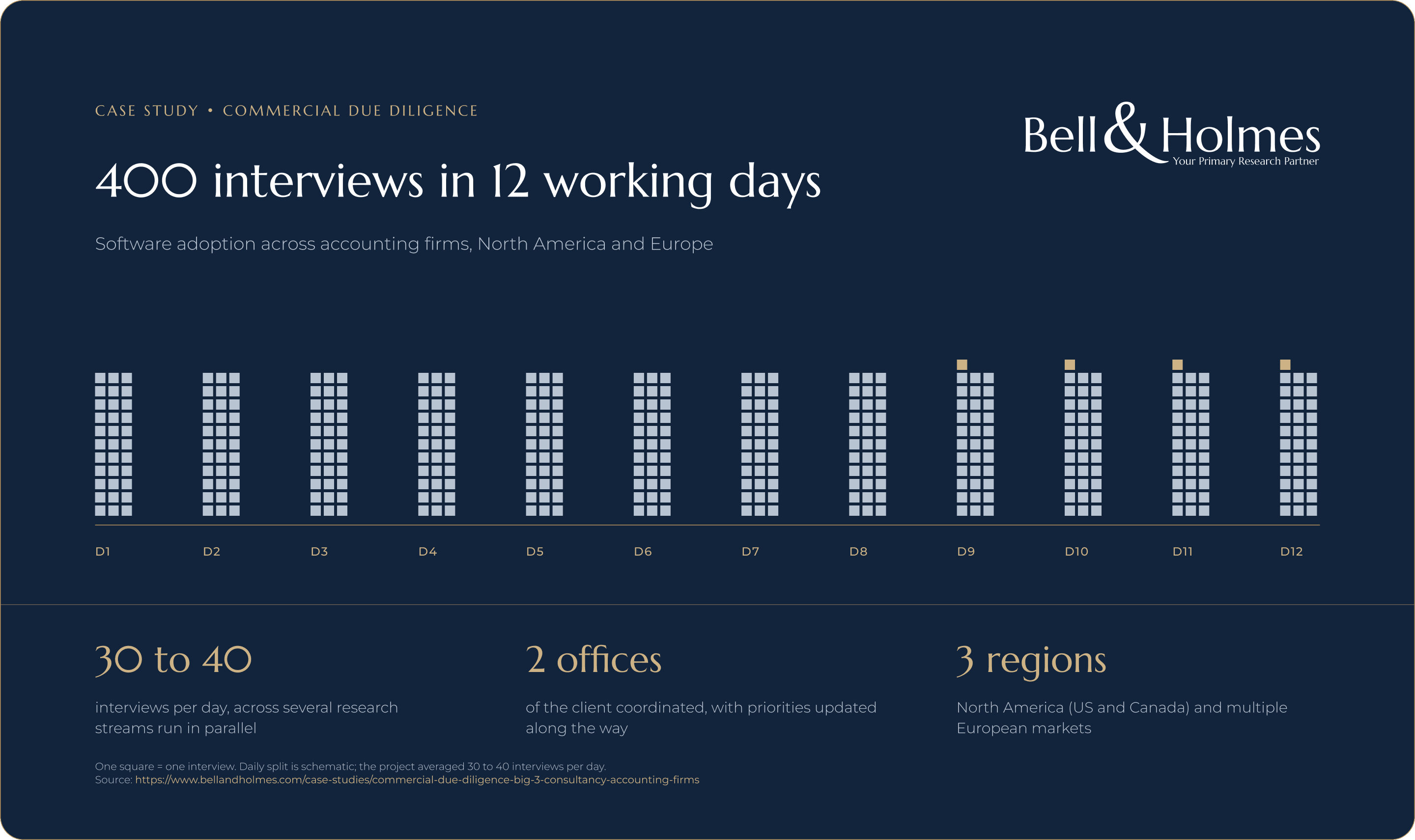
We use AI to screen contact lists and ask the follow-up questions in Survey Intelligence. People review every interview and approve every response before it reaches a client. On a 12-day accounting software due diligence across the US, Canada and Europe, the client kept reprioritising questions and requesting call-backs, and the team still completed about 400 interviews at 30 to 40 a day.
MIT Sloan's John Horton calls LLM simulation a dress rehearsal for expensive research: companies "might build and test three or four variants of something, but they're not going to test 700,000." Horton co-founded Expected Parrot, a persona-research platform, so he is not neutral. His framing still holds. AI prepares a decision well but makes a weak basis for signing one off.
AI fails in three predictable ways
AI averages out the people you most need to hear, knows little about markets nobody writes about, and can feed its own output back into your dataset. A better model release fixes none of these by default.
- Synthetic respondents average out the minority view. James Bisbee and colleagues at Vanderbilt compared ChatGPT personas with matched American National Election Study respondents in a 2024 paper in Political Analysis. Synthetic answers resembled human averages but varied less, shifted with prompt wording and changed over three months. In their regressions, 48% of coefficients differed significantly from the human estimates, and 32% of those reversed sign. B2B samples drift the same way. In an Emporia Research comparison of LinkedIn-verified IT decision-makers and AI-generated personas, 47% of real respondents were "somewhat satisfied" with their role, while 69% of synthetic ones were "strongly satisfied". In diligence, the finding is often the minority view, and synthetic samples erase it.
- Models know least about markets nobody writes about. Models learn from what people have already written, so their forecasts hold only until a market breaks with its past. In a 2023 working paper, Olivier Toubia's team found that AI-elicited demand curves differed from human ones and were implausible. Santurkar and colleagues showed in 2023 that LLM opinions skew toward liberal, well-educated groups and under-represent people over 65. Owner-operators in US trucking, county finance officers and presidents of engineering firms rarely publish their buying criteria. A model trained on the open web has little to go on.
- AI-touched data can hand your assumptions back to you. An AI tool drafts the screener, panel respondents write open-ends with AI assistants, and an LLM summarises the result. Each step is defensible alone, but the chain can return a deal team's own assumptions in cleaner formatting, sometimes with a hallucinated quote along the way. In Bell & Holmes internal data from 2026, a PE deal team found six different "VPs of procurement" using the phrase "streamline our vendor consolidation efforts" in one week of panel open-ends. Fully synthetic respondents are the loud version of this problem, covered in our piece on synthetic respondents. Counter-evidence exists. Stanford and Google DeepMind researchers built generative agents of 1,052 Americans from two-hour interviews and surveys, in a study revised in 2026. On held-out General Social Survey items, interview-based agents reached 83% of participants' own two-week retest consistency, against 74% for agents built from demographics alone. Every agent started from a real person's answers.
- Your brief is also a data-protection risk. Uploading a CIM, a customer list or transcripts into a public AI tool can breach an NDA, and transcripts carry personal data covered by GDPR. Ask every supplier where your brief and transcripts are processed and whether either trains a model. GLG states that client calls, transcripts and AI summaries never train its models. A supplier who cannot answer quickly has probably never been asked.

AI moderation beats human interviewers on consistency, scale and cost
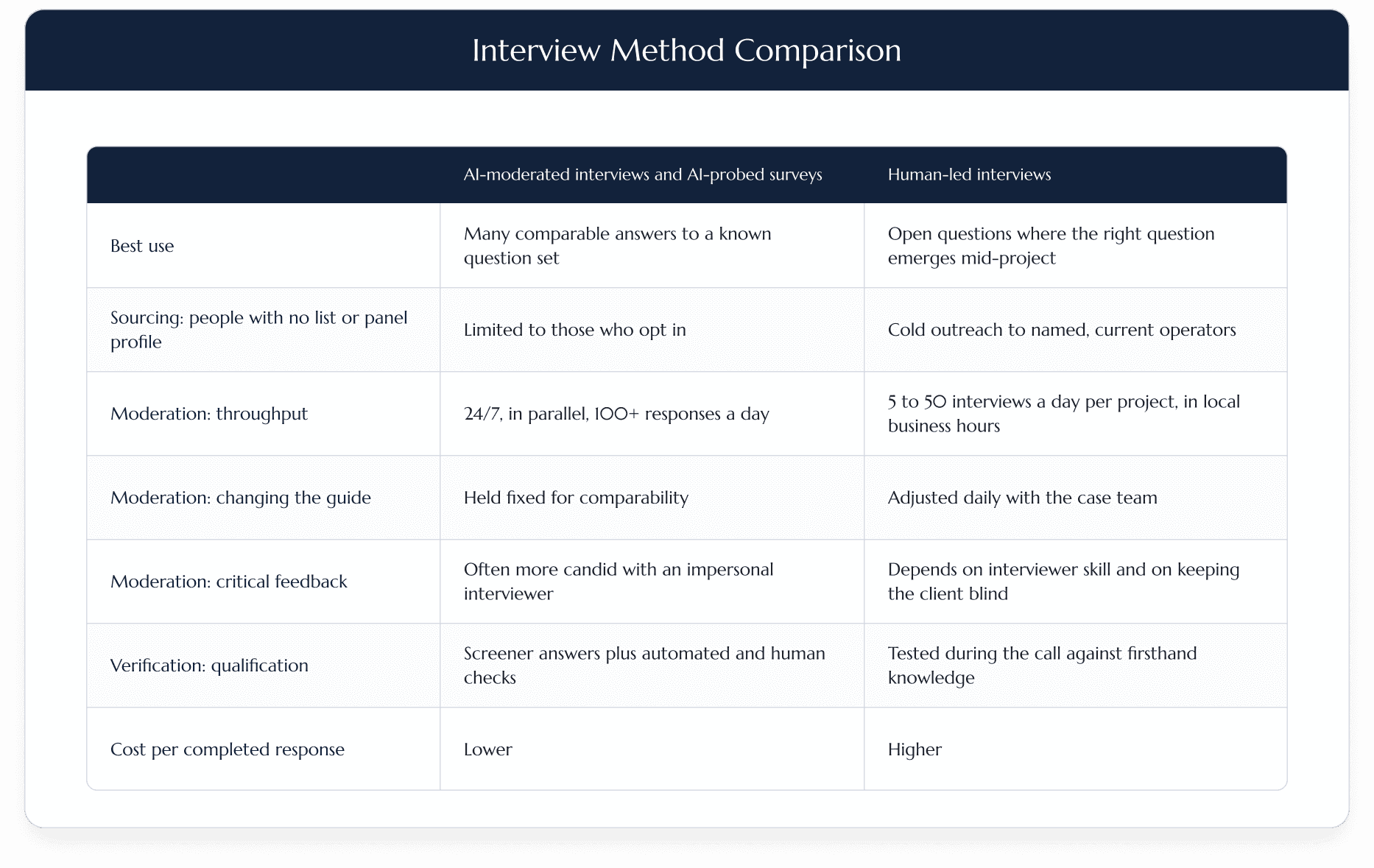
AI-moderated interviews win on consistency, scheduling and cost per response. Sometimes they win on candour too.
Horton notes that AI can be a more neutral party for drawing out negative feedback, and the WeightWatchers research team, an Outset.ai customer, told Columbia's authors that participants were often more forthcoming with an AI interviewer. GLG, which sells AI-moderated calls, reports that about 45% of them run outside working hours.
Moderation is only one of the three jobs. An AI moderator can only talk to people someone else has already found, so a CIO who never joined a panel will never reach it. Automated checks can confirm devices, connections and behavior, but they cannot confirm what a person knows.
Survey Intelligence keeps those jobs apart. Respondents answer open questions by voice, and after each answer the system asks a follow-up drawn from the brief agreed with the client. Automated guardrails check identity, IP address, voiceprints, browser fingerprints, duplicates and speeding. A person then reviews every interview, whether it was flagged or not. A typical study goes live within 24 hours and collects 100+ responses a day in 10+ languages.
That design answers a measured problem. Kantar's Jane Ostler and Qi Wang reported in 2024 that clients reject up to 40% of panel data after fieldwork as low quality, and that fraud accounts for 69% of quality flags.
Human interviewing hit its limits on our own projects
Human interviewing hits two limits: time and the size of the contact pool. It also costs more per response, cannot run at 3 a.m. in the respondent's time zone, and varies with the interviewer.
In Romania and Serbia, four working days were not quite enough, and the team added half a day to reach the target. On a 20-day county finance software study, the contact pool narrowed and a state-agency stream was harder to reach, so the team re-prioritized by county size to hold volume at about 320 interviews.
Extra compute fixes neither limit. When the question is well defined, the audience can be reached at scale, and you need 400 comparable answers by Friday, an AI-probed survey is the better instrument.
Keep three calls with humans because they move a valuation: who you talk to, whether they qualify, and what you ask next. Give AI the work that multiplies a question you already trust.
Andreessen Horowitz reports that many CMOs accept AI research outputs as at least 70% as accurate as consulting work, while noting that the category has no established accuracy benchmarks. That trade suits a message test. One wrong assumption about churn, however, can move a valuation at investment committee.
On an IC memo, market size, satisfaction and NPS need breadth from a verified survey. Churn risk, switching costs, unmet demand and the reasons behind a score need qualified interviews. Red flags need both. The survey shows that something is off, and the interviews explain whether it changes the valuation.
Before any AI-generated dataset reaches that memo, ask the supplier five questions:
- Who answered, and how were they found? A named role at a disclosed type of company is evidence. "Our panel" is a claim.
- Would the result survive a different prompt or model? Horton argues that simulation results must be replicable, with models and prompts on record.
- Has anyone checked it against a human baseline? The Stanford and DeepMind study did. Vendor-run tests help but are not independent, such as the EY and Evidenza study, reported by Columbia Business School, in which synthetic CEO personas reached conclusions "95% the same".
- Is every AI step disclosed? Synthetic respondents, AI moderation, coding and summarising each change what the data means.
- Did a person review every response before release? Automated flags remove the bulk, and a human pass decides the rest.
A dataset that fails questions 1 and 5 is not decision-grade, however good the dashboard looks.
Most programmes we scope combine Survey Intelligence for verified breadth, Direct Interviews for hard-to-find decision-makers and questions that did not exist on day one, and AI synthesis across both. Our piece on the human + AI hybrid model describes how that works day to day.

AI will replace research labour, not research evidence
Will AI replace market research? AI will replace much of the labour, from drafting and coding to first-pass translation and structured data collection. A model can only report what someone has already said, so when the answer depends on what operators think this quarter, someone still has to ask them.
Send us your brief before choosing a method. We will mark, question by question, which parts AI can prepare, which need a verified survey and which need a qualified person on the phone. Talk to the team, or read the case studies behind the six tasks first.
Our services
From hypothesis to investment-ready evidence

One operating standard across all levels of depth, and no vendor change when the question gets harder
Where we operate
Traditional Surveys
Survey Intelligence
How it works →Direct Interviews
See the process →Expert Network
Not sure which approach your project needs? We will point you to the ideal one that still answers it.