18/08/2026
Commercial Due Diligence in Mid-2026: Why Confirmatory-Only Research Now Loses Deals
At 11.8x entry multiples, confirmatory-only commercial due diligence loses deals. Why PE teams now start primary research before the LOI.
When you conduct primary research determines whether it can still influence the transaction. It is not about the standard of the work, but when it happens. Anyone who has accepted a diligence mandate on Friday for a Monday IC knows the problem: once the calls are completed, the investment case is already locked in and research merely validates it. That approach was viable when entry valuations allowed for mistakes. At mid-2026 valuation levels, it is not.
That is the central point of this piece. Commercial due diligence - the forward-looking assessment of whether a target’s market standing, resilient demand, and ability to sustain pricing will endure - has not fundamentally changed. What has changed is the price of learning you were wrong late in the process rather than early. Teams that price top-tier assets most effectively are moving primary research into screening and pre-LOI stages, when it can still invalidate a weak thesis before capital and senior time are tied up. The cost analysis that follows shows why this shift is now essential.
What changed in commercial due diligence by mid-2026
The cost math moved, not the definition. Buyers are paying more and borrowing less, so the commercial thesis has to carry the return on its own.
Median buyout entry multiples hit a record 11.8x EBITDA in 2025, up from 11.3x the year before, according to McKinsey's Global Private Markets Report 2026. Over the same period, debt fell to 37% of entry multiples, down from a 44% average across 2010 to 2022. Read those two numbers together. You are paying a record price for the equity and funding more of it yourself, which means multiple expansion and cheap leverage are no longer doing the work. Operating performance is.
The returns confirm the squeeze. Top-quartile global buyout funds returned roughly 8% on a pooled IRR basis in 2025, against 18% for the S&P 500 and 22% for the MSCI World, per the same McKinsey report. Bain reached the same destination by a different road in its Global Private Equity Report 2026, which argues that "12 is the new 5": today's deals demand far faster EBITDA growth just to clear the hurdle that a 5x once did. When the entry price assumes growth, the diligence question is no longer "is this a good company." It is "will this specific thesis hold." Get that wrong and the penalty is now brutal.
Confirmation-focused research fails when it comes too late to shape the decision it was supposed to guide. By the IC stage, partner hours, legal costs, and the reputational force of a formal recommendation are already committed. Finding that the thesis is flawed at that point does not protect the deal. It simply reveals an issue you can no longer readily reverse.
Consider a specific example. A team screens a specialty distributor, is attracted by its recurring-revenue profile, and launches a full commercial diligence process designed mainly to validate the case. Customer calls are completed in the third week. Around half of those interviewed point to a competitor’s new direct-to-site offering, which management had never mentioned. This is not a minor observation. It signals that the demand-durability premise is failing, uncovered at precisely the most costly stage to respond. If those interviews had taken place during screening, the team could have repriced the opportunity or walked away with only a small portion of the eventual sunk cost.
The market has already repriced this risk. 71% of general partners now say they prioritise operational improvement over financial engineering, per S&P Global Market Intelligence's 2026 Private Equity and Venture Capital Outlook. If the return depends on running the business better, the thesis about how the business actually works has to be tested early enough to change the price you pay for it. Financial due diligence tells you the numbers were real. Commercial due diligence tells you whether they will keep being real. Only one of those questions gets easier to answer the earlier you ask it.
There is a second cost that rarely makes it into the post-mortem: optionality. At screening you can still walk, reprice, or restructure the deal without spending political capital. By IC, the deal has sponsors inside the firm, a data room full of legal hours, and a management team that has been told this is happening. Late-breaking commercial findings do not just cost money. They force the deal team to argue against its own prior recommendation, which is a harder thing to do than most diligence budgets assume. The teams that avoid that position are not smarter. They just moved the discovery work to a point where changing their mind was still cheap.
The commercial due diligence process, resequenced
The fix is to move primary research to the front and change what each stage is for. Screening kills weak theses cheaply, pre-LOI does the deep work, and confirmatory becomes validation rather than discovery.
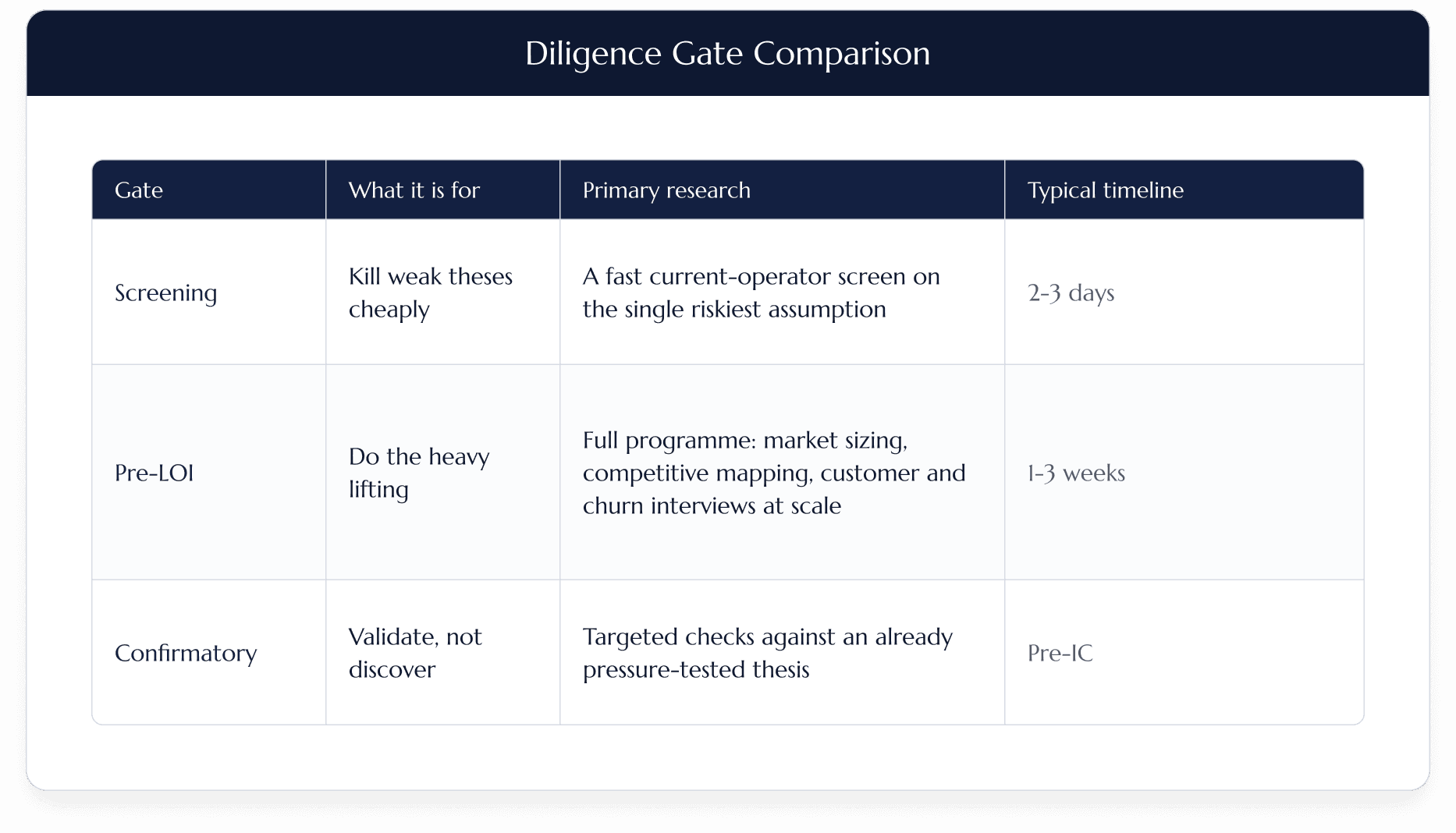
Here is the three-gate model in practice. At screening, run a fast, focused batch of current-operator interviews against the single riskiest assumption in the thesis. Current operators, not former employees, and enough of them to actually test the assumption rather than a token call or two. The goal is disqualification: you are trying to break the thesis early, while walking is still cheap. Bell & Holmes typically ramps a project inside 12 to 24 hours and returns first interviews within 48, so a real sample lands in days, not weeks, which is what makes a proper screen affordable this early.
At pre-LOI, the commercial due diligence process does its heaviest lifting. This is where market sizing and TAM analysis, competitive landscape mapping, customer switching behaviour, and a genuine challenge to the management plan belong. Volume matters here, within reason. Most commercial due diligence programmes run on 30 to 50 interviews, scaled up only when the decision genuinely warrants it, and a mid-market team can move fast enough to take 5 to 50 conversations a day at roughly 15% to 25% of the cost per interview of a traditional expert network. That combination, expert-network depth at a sample you can actually field before the LOI, is what makes early primary research affordable enough to change the price rather than confirm it.
By the time you reach confirmatory, the surprises should be gone. This gate exists to validate a thesis you have already pressure-tested, tighten the value-creation plan, and hand the deal team a defensible answer for IC. When it turns up something new, that is a signal the earlier gates were run too thin, and it is worth treating as a process failure rather than a lucky catch.
This is grounded in practice, not theory. In a Big Four-led CDD, a private equity investor was assessing a B2B software business serving a specialised, regulated SME market in Europe and North America. We were engaged to deliver the primary-research workstream within a 10-day timeframe. Over eight working days, we carried out more than 140 interviews in Germany, France, and the United States, all conducted in the relevant local language.
The research identified substantial unmet demand for a compliance module that the target had yet to commercialise. This insight supported an update to the growth assumptions in the investor memorandum. It is an example of pre-LOI research serving its intended purpose: changing the model while valuation remained negotiable, rather than surfacing only after the deal team had already backed a recommendation. The full Big Four CDD tight-timeline case sets out the brief and the findings.
A finding only earns a reprice if the evidence behind it holds. That is a sourcing question before it is an analysis question. Every participant in that study was individually sourced, verified in role, and contacted directly by cold call, with no open survey links or panel pools that let bots or synthetic responses in, and a four-eyes audit on the transcripts to catch textbook-perfect answers. When you are going to move a valuation on what 140 people said, you have to know those 140 people were the current operators you meant to reach.
Mapping research to the thesis: a four-to-six pillar framework
A commercial due diligence framework works when every question maps to an investment pillar. If a call does not change or validate an assumption, the problem is your questioning, not the market.
Plan the research backwards from the pillars, not forwards from a questionnaire. Build the framework around four to six pillars that carry the return. For most buyouts they are pricing power, demand durability, competitive moat, and, increasingly, AI exposure: whether the target's product or cost base is about to be reshaped by automation on either side of the trade. Add sector-specific pillars where the thesis demands them. Each interview, each data point, and each survey question then sits under a named assumption it is there to test.
AI exposure remains a blind spot for many teams. It can cut in either direction: automation may threaten a target’s core offering, or it may materially reduce the cost of delivering that offering. A distributor reliant on a telephone-based sales operation may be vulnerable. By contrast, a services business able to automate 30% of its delivery costs could be more attractive than the base case suggests. Historical financials will reveal neither dynamic. Both can emerge quickly through operator interviews, provided the questions are raised during screening rather than added retrospectively at IC.
The discipline this enforces is subtractive. Ask of every planned question: which pillar does this move? If the honest answer is none, cut it. A tight framework is why a resequenced process can run at screening speed without losing rigour, because the team is only ever asking questions that can flip a decision. It also travels across the deal. The same pillar map that structures buy-side commercial due diligence carries into vendor due diligence on exit, where you are validating the same assumptions from the sell side, and into the first-100-days value-creation plan, where the pillars become the operating priorities.
Where this breaks
Early primary research is not always the right call, and pretending otherwise costs credibility. There are two situations where the resequenced model genuinely strains, and one common objection that does not hold up.
The first exception is a proprietary opportunity with a truly compressed timetable. If a founder grants only ten days of exclusivity, there may be no practical way to front-load a full research programme. In that situation, the answer is a streamlined screen and greater reliance on operator relationships already in place.
The second is a market where credible expert access is limited. Certain regulated, public-sector, or defence-adjacent sectors do not have enough relevant current operators to support a robust interview sample. Rather than pursuing interviews that are unlikely to materialise, diligence should place more weight on secondary evidence and established specialists.
Check size, however, is not a convincing reason to omit primary research. Smaller transactions are often where an incorrect decision has the greatest impact relative to fund size. A properly scoped primary check - a focused but comprehensive screen rather than a full-scale programme - costs little compared with discovering a problem once it is too late. For a target below $50 million, the proportionate response is a smaller interview sample, not no primary research at all.
None of this undoes the core argument. It sharpens it. The claim is not "always run more primary research." It is "run it early enough to matter, right-sized to the deal, and be honest about the deals where the sourcing genuinely will not come." A team that knows where its deals actually strain is already ahead of one that runs the same confirmatory template on all of them.

A working commercial due diligence checklist for mid-2026
Use this as a resequenced due diligence checklist, organised by gate rather than by workstream. It assumes the thesis-pillar framework above is already written.
At screening (target: 2-3 days)
- Name the single assumption that, if false, kills the deal. Write it as one sentence.
- Run a fast current-operator screen against that assumption only - enough interviews to test it, not a token call or two.
- Confirm the demand story is not resting entirely on management's own account.
- Decision: proceed, reprice, or walk. Log the reason.
At pre-LOI (target: 1-3 weeks)
- Complete market sizing and TAM analysis with a bottom-up cross-check, not just top-down.
- Map the competitive landscape, including entrants and adjacent-model threats management may downplay.
- Interview across customers, churned accounts, and channel partners - 30 to 50 is typical, more only where the decision genuinely warrants it.
- Test switching behaviour and pricing power directly, in customers' own words.
- Challenge the management plan line by line against what operators actually report.
- Separate financial due diligence findings from commercial ones, then check where they disagree.
At confirmatory (target: pre-IC)
- Validate, do not discover. Any genuinely new red flag here means the earlier gates were run too thin.
- Stress-test the value-creation and first-100-days plan against the primary evidence.
- Assemble the defensible answer for IC: named sources, sample sizes, and the assumptions each finding moves.
- Flag every claim that rests on a single source, and decide whether that exposure is acceptable to sign against.
The value of this version is not that it lists more. It is that it runs the same questions in the order that lets them change the deal.

The position, once more
Confirmatory-only commercial due diligence is not wrong. It is late. At 11.8x entry multiples with returns riding on operations rather than leverage, the research that arrives after the decision cannot change it, and the teams still treating primary work as a final checkbox are underwriting a thesis they have not actually tested. Move the calls forward. The open question is not whether early primary research pays off on the deals you win. It is how many of last year's losses were theses that a two-day screen would have killed.
That question is worth sitting with before the next IC.
When it changes how you sequence a live deal, the next step is small: a 20-minute scoping call that ends with a budget, timeline, and expected output, and no obligation to proceed. To see the resequenced model on real deal timelines first, the commercial due diligence case studies walk through it.
Article Q&A
What is commercial due diligence in M&A?
Commercial due diligence is the forward-looking assessment of a target's market position, demand durability, competitive moat, and pricing power, used to test whether an investment thesis will hold. It answers "will the numbers keep being real," where financial due diligence confirms the numbers were real in the first place.

Who leads commercial due diligence in private equity?
The deal team owns the thesis, but the primary research behind it is usually run by a specialist CDD provider or a commissioned primary-research partner. The shift in mid-2026 is when they are engaged: leading teams bring that partner in at screening, not just at confirmatory stage.
When should primary research start in a commercial due diligence process?
At screening. A fast, focused round of current-operator interviews against the single riskiest assumption can disqualify a weak thesis in days, before partner time and legal spend are committed. Pre-LOI is where the deeper work belongs, typically 30 to 50 interviews; confirmatory should validate, not discover.
Our services
From hypothesis to investment-ready evidence

One operating standard across all levels of depth, and no vendor change when the question gets harder
Where we operate
Traditional Surveys
Survey Intelligence
How it works →Direct Interviews
See the process →Expert Network
Not sure which approach your project needs? We will point you to the ideal one that still answers it.