10/07/2026
Human Ground Truth: Why Expert-Led Native-Language Interviews Resist AI Interference
Subject matter expert interviews are the human ground-truth layer that keeps AI-era research honest. How to run them, what to ask, and where they beat data.
Most research budgets are quietly funding a lie. A subject matter expert interview is a structured conversation with a practitioner who has direct, hands-on experience of a market, product, or process, run to surface what public data cannot show. That definition sounds simple. The problem is that the market is now flooded with content, panels, and datasets that look like expert input but were never anywhere near an expert. When your deal thesis rests on that difference, the interview stops being a research method and becomes a control check on everything else you were told.
This is not an argument against AI. It is an argument about where the ground truth comes from. AI models are only as reliable as the human signal underneath them, and that signal is getting harder to verify. A live interview with a screened expert is the one input you can trace back to a real person who answered a real question. That traceability is why it holds up when a partner starts pulling on threads in the investment committee.
If you are sourcing expert calls for a deal that closes in two weeks, that is the standard your evidence has to meet, and it is the standard the rest of this piece is about.

What a Subject Matter Expert Interview Actually Is
A subject matter expert interview gathers experience-based perspective from someone with practical authority in a specific field, then uses it to validate a hypothesis, map a market, or pressure-test a decision before you commit capital. Expert networks and primary research firms alike frame it the same way: a qualitative method for gathering firsthand insight to validate hypotheses and refine strategy. The value is in the source. You are speaking to the person who ran the procurement, switched the vendor, or sat through the failed implementation.
There is a taxonomy worth knowing. Informational interviews establish how a market or process works in practice. Exploratory interviews surface themes and open questions you did not know to ask. Evaluative interviews test existing data or a specific hypothesis against a practitioner’s judgment. Most diligence projects use all three inside a single program, moving from informational early to evaluative once the thesis sharpens.
The same method extends beyond deal work. Litigation and expert-witness teams rely on the identical discipline when a screened specialist has to give an account that will hold up under challenge.
Expert interviews sit downstream of secondary research, not instead of it. You read the public reports first, identify what only a practitioner can answer, then design the interviews to close that gap. Skip the desk work and you waste expensive expert time confirming things a database would have told you for free.
Why Expert Interviews Are the Human Control Layer in an AI Evidence Mix
Expert interviews resist AI interference because they produce a verifiable human record at the exact point where synthetic content is hardest to detect. The rest of your evidence stack is increasingly machine-made. Gartner predicted that by 2024 more than 60% of the data used to train AI and analytics models would be synthetically generated rather than drawn from the real world. Layer on the fabrication problem documented in Christoph Nichau’s LinkedIn analysis of a single secondary market report, which traced 771 references back to 153 “factories” with no verifiable existence, a data-integrity problem we examined in detail in our review of secondary-market research. When machine-made sources can pass a citation check, the scarce input becomes the one you can name, screen, and call back.
Treat the human interview as the control group, not the whole experiment. AI is genuinely useful for the surrounding work: sifting public filings, clustering themes across transcripts, drafting the first synthesis. What it cannot do is originate a first-hand account and stand behind it. When a model summarises “what the market thinks,” you have no way to audit whether that consensus came from practitioners or from other machines repeating each other. A screened interview breaks that loop because there is a person on the other end of the line.
This is why the hybrid model matters more than the old survey-versus-network argument. The useful question is which mix of expert access, survey input, and managed interviews gives you evidence you can defend, with the human conversations acting as the layer that keeps the rest honest.
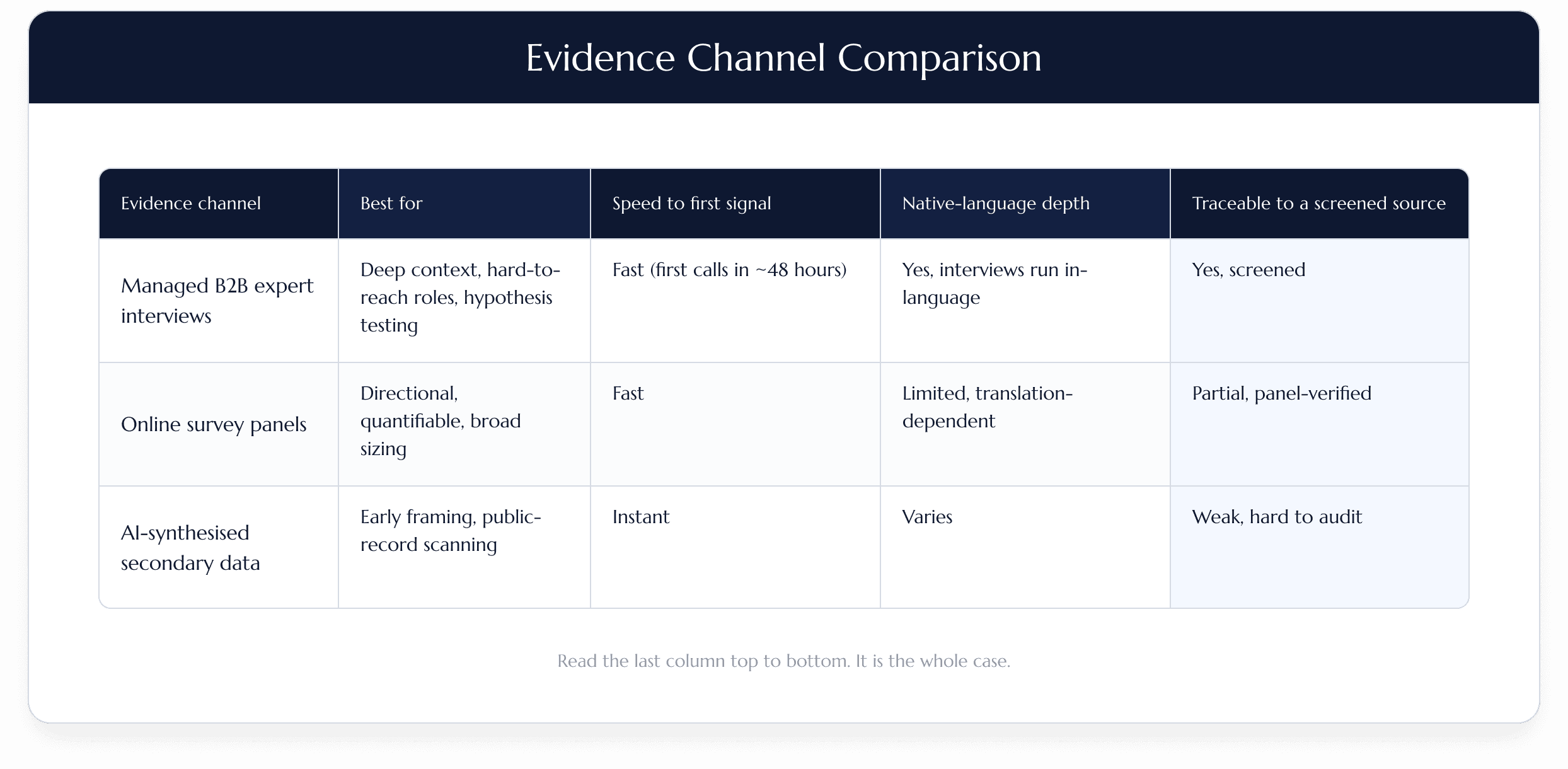
Read the last column top to bottom. It is the whole case.
How to Run One: Plan, Guide, and the Questions That Matter
A strong expert interview is decided before the call connects, in two documents: the interview plan and the interview guide. The plan selects the right experts by working backward from the decision you need to make. Define the action first, then the intelligence required to support it, then the specific people who hold that intelligence. “Classic” expert networks typically describe building keyword profiles of the ideal expert’s background rather than chasing job titles, and that is the right instinct.
The guide is a mechanical exercise, not a creative one. You translate the intelligence you need into open-ended questions, strike anything secondary research already answered, and sequence the interviews so each one builds on the last. Analytical frameworks like Porter’s Five Forces or a SWOT structure can help you convert broad themes into discrete questions, but the guide should read like a practitioner’s agenda that a busy operator would recognise as their own.
For teams searching directly for subject matter expert interview questions and domain expert interview questions, here is a working bank you can adapt across a diligence or strategy program:
- Walk me through the last time you selected a vendor in this category. What actually drove the decision?
- What would someone outside this industry consistently get wrong about how it operates?
- Where does the published data on this market diverge most from what you see on the ground?
- Which competitors are gaining or losing ground right now, and what is the mechanism?
- What would have to change for you to switch providers, and what keeps you locked in today?
- If you were advising a buyer entering this space, what is the risk they would underestimate?
Notice what these have in common. Each is open-ended, each targets first-hand experience, and none can be answered with a yes or no. That is the difference between an interview that generates conviction and one that generates filler.
What a Scheduled Expert Call Won’t Tell You
The most valuable answer in diligence is usually the one a scripted, chaperoned expert call is built to avoid. The classic expert-network model runs curated, compliance-gated conversations, and the polished official line that comes out of them is often the least useful thing you can put in front of a deal team. The candid version, why an incumbent is quietly losing accounts, where a category is breaking, what a buyer is about to regret, rarely surfaces on a monitored call with a pre-cleared script.
Investigative primary research is built to get past that. Bell & Holmes reaches operators through active outreach and gets them talking about how a market actually behaves, not how it is supposed to look in a vendor deck. That is the point of primary research done well: uncovering the ground-level reality that curated sources leave out, so the deal team is working from what is true rather than what is convenient to disclose.
Where Interviews Alone Fall Short
Expert interviews are not statistically representative, and treating them as if they were is the fastest way to draw a wrong conclusion. As Silverlight Research notes in its overview, these conversations reflect individual experience and are one input among several, not a standalone source of truth. A focused set of deep interviews will tell you how a market behaves and why. It will not tell you the precise size of it.
Use interviews for depth, causation, and the “why” behind a number, then triangulate the “how much” against surveys or hard data. The honest limitation is real: synthesis across many qualitative conversations takes skill, and a weak analyst can turn ten good calls into a muddled summary. That risk is a reason to invest in the synthesis, and to demand a skilled analyst from whoever runs your interviews.
What Decision-Grade Execution Looks Like
The gap between a mediocre and a decision-grade interview program is execution under pressure, and that is where Bell & Holmes is built to operate, at deal speed, with a high N. We are a hybrid primary research partner for private equity, consulting, and corporate strategy teams, combining active expert sourcing, native-language B2B interviews, survey capability, and synthesis-ready output under one coordinated model. First interviews typically land within 48 hours, across 140-plus countries and more than 35 languages, run by trained research consultants who understand the sector before they dial.
Verification is a process, not a promise, and it is worth seeing the steps. We start from the decision the client needs to make and build a target spec for the exact respondent who can answer it. We then source those people actively against that spec, using proprietary databases rather than a pre-recruited panel, and screen each candidate for genuine first-hand relevance before they reach the client. The respondent’s background is confirmed against the spec, and the client can see the sourcing logic behind every call. That audit trail is what separates a screened interview from an anonymous panel response.
One published example shows the standard. A European consulting firm engaged us on a commercial due diligence for a highly specialised compliance software used by hedge funds and asset managers, with the end client assessing market viability across Europe and North America. Traditional expert networks struggle with a target this narrow, because the people who actually run these regulatory workflows do not sit in a ready-made panel. We sourced and screened those decision-makers directly, ran the conversations in their own languages across multiple European and North American markets, and delivered competitive intelligence granular enough to shape an active diligence recommendation. The respondents were chosen for relevance rather than convenience, because the point is one call producing one slide of clarity from an operator who has actually done the job.
Native-language matters more than it looks. On a strategy project covering the food supplement and OTC landscape in Romania and Serbia, public data was thin and qualified stakeholders were hard to reach, so the value came entirely from talking to local operators about pricing, sales channels, and the regulatory environment in their own markets and language. A senior operator gives you a sharper answer in their own language than in negotiated English, and in niche markets like these that difference is often the exact detail your thesis turns on. Verification works the same way: when you can confirm the respondent’s relevance against the spec and stand behind the record, you can hand a partner both the transcript and the sourcing logic behind it. In a market where most training data is now synthetic, that auditable trail is the whole product.

Winning Versus Walking Away
Every deal comes down to a decision you can defend or one you cannot. Secondary data and AI synthesis will get you to a hypothesis. A screened, native-language expert interview is what tells you whether that hypothesis survives contact with someone who actually runs the market. That is the difference between winning a deal on conviction and walking away from a good one because the evidence felt thin.
If you are staring at a compressed timeline and a thesis that still has holes in it, that is the moment to talk to us. Partner with Bell & Holmes and we will have your first expert interviews underway within hours, not weeks.
Article Q&A
What is a subject matter expert interview? A subject matter expert interview is a structured conversation with a practitioner who has direct, hands-on experience of a market, product, or process. It is used to validate a hypothesis, map a market, or pressure-test a decision with firsthand knowledge that public data and secondary reports cannot provide. The value sits entirely in the source: you are speaking to the person who actually ran the procurement, switched the vendor, or lived through the implementation.
What questions should you ask in an SME interview? Ask open-ended questions that target first-hand experience and cannot be answered yes or no. Strong examples include: “Walk me through the last time you selected a vendor in this category and what actually drove the decision,” “Where does the published data on this market diverge most from what you see on the ground,” and “What would have to change for you to switch providers, and what keeps you locked in today.” The goal is to surface the reasoning behind a decision, not to confirm a number you already have.
How many expert interviews do you need for due diligence? There is no fixed number, because expert interviews are built for depth rather than statistical representativeness. A focused set of well-screened interviews will tell you how a market behaves and why decisions are made, then you triangulate the sizing against surveys or hard data. What matters more than raw volume is respondent fit: a handful of genuinely relevant, verified operators outperforms dozens of loosely-matched panel responses.
What is the difference between an expert network and a primary research firm? An expert network primarily connects you to vetted experts for calls you run yourself. A hybrid primary research firm like Bell & Holmes sources and screens the respondents, conducts the interviews in the respondent’s native language, and delivers synthesis-ready output, combining expert access, survey capability, and managed B2B interviews under one coordinated model. The practical difference is who holds accountability for respondent fit and the quality of the final evidence.
Can AI replace expert interviews? No, but it can support them. AI is useful for sifting public filings, clustering themes across transcripts, and drafting a first synthesis. What it cannot do is originate a first-hand account and stand behind it, which matters more as synthetic data grows: Gartner predicted that by 2024 more than 60% of data used to train AI and analytics models would be synthetically generated. A screened human interview is the traceable control layer that keeps the rest of an AI-assisted evidence mix honest.
How do you verify that an expert is who they claim to be? Verification is a process, not a promise. It starts with a target spec built from the decision the client needs to make, followed by active sourcing against that spec, screening each candidate for genuine first-hand relevance, and confirming their background before they reach the client. The sourcing logic behind every call is auditable, which is what separates a screened interview from an anonymous panel response.
Our services
From hypothesis to investment-ready evidence

One operating standard across all levels of depth, and no vendor change when the question gets harder
Where we operate
Traditional Surveys
Survey Intelligence
How it works →Direct Interviews
See the process →Expert Network
Not sure which approach your project needs? We will point you to the ideal one that still answers it.