04/09/2026
Commercial Due Diligence Across 140 Countries: What Breaks Between the Proposal and the Fieldwork
What breaks between the country list in a CDD proposal and the fieldwork that delivers it: feasibility, timelines, and what to confirm before committing coverage.
The country list goes into the deck before anyone has checked whether the respondents exist.
That is not a criticism of how deal teams scope commercial due diligence. It is a consequence of how the work is sold, and usually of how little time there is to sell it. A fund gives an advisor days to respond, the client asks for coverage across the target's footprint, and the proposal commits to it because the alternative is losing the mandate to a firm that will. Whether forty distributors in Malaysia can actually be reached inside a three-week window gets answered later, by whoever is running the fieldwork. Usually in week two. Occasionally, in a call nobody enjoys.
This piece is written from that side of the engagement. Bell & Holmes has run the primary research layer on over 1,000 commercial due diligence, red flag, and strategy projects since 2021, including work for more than 30 offices of Big Three consultancies. What follows is what we have learned about which country lists are deliverable, which are not, and what a commercial due diligence checklist should ask before coverage gets committed to a client.
The country list problem
Coverage gets promised on the target's revenue map, not on the respondent map. Those two things look identical in a CIM and behave nothing alike in fieldwork.
A target with 18% of revenue in Japan and 6% in Poland produces a proposal that treats both as secondary markets worth a handful of interviews each. In practice one of those is a three-week problem and the other is a three-day problem, and which is which depends on factors that do not appear anywhere in the data room. Whether a usable contact list exists. Whether the decision-maker you need answers a phone. Whether anyone on the team can hold a technical conversation in the local language on day one rather than day nine.
Cross-border exposure is climbing, which makes this a more frequent problem than it was. McKinsey's 2026 M&A trends analysis reports that within-region trading accounted for 81% of 2025 corporate deal value, down from 85% the year before. PwC's 2026 mid-year outlook puts the Americas at 61% of global deal value but only 28% of global deal volume. More deals are happening outside the markets where most deal teams have native reach.
If you have ever had to go back to a client mid-diligence and explain that one market is coming in light, you already know the cost is not the missing interviews. It is the credibility of every other number in the deck.
What actually determines whether a market is workable
Four variables usually determine whether a market is workable, and none of them are visible from the buy-side seat. They also do not correlate with distance, market size, or how developed the economy is.
Respondent density against your screening criteria. This is the one that quietly destroys timelines. If your spec requires a plant manager at a mid-sized specialty chemicals producer who has switched suppliers in the past 24 months, the number of humans on earth who qualify may be in the low hundreds, and they are not evenly distributed. A tight spec in a fragmented market means the arithmetic gets punishing fast: at a one-in-forty qualification rate, thirty completed interviews means working through roughly twelve hundred contacts. That is a sourcing operation, not a calling exercise, and it is the difference between a five-day market and a three-week one, which is why market assessment timelines are set by fieldwork, not analysis.
Whether a usable list exists at all. Clients frequently provide one. It frequently does not survive contact with the phones. On a US trucking CDD for a Big Three consultancy, the provided list proved unworkable on day one and the entire respondent pool had to be built independently: 105 interviews delivered in seven working days. Same pattern on a North American ranching CDD, where 31 interviews came out of five days after the client's data proved thin. Both were single-country US projects. Sourcing difficulty tracks how fragmented and unlisted the respondent population is, not how far away it lives.
In-language capability on day one. Not translation. Not a bilingual interviewer scheduled for next week. Someone who can open a cold call in the local language, hold a technical conversation about procurement or switching behaviour, and pick up hesitation. In-language outreach improves willingness to engage and the depth of the conversation. The same person, approached in English about regulatory workflows, gives you a shorter and more guarded answer, if the call happens at all.
Business-hours overlap. Straightforward arithmetic that gets forgotten in scoping. A team calling from US Pacific into Singapore has almost no shared working day. Add a European leg and the usable calling window in each market compresses to a few hours, which caps daily throughput regardless of how many interviewers are on the project. In many multi-market programmes, the binding constraint is local calling time rather than total headcount.
There is a fifth factor worth naming because it is seasonal rather than structural: large parts of continental Europe are effectively unreachable for stretches of August, and several Asian markets have equivalent windows. A three-week fieldwork plan that crosses one of those is not a three-week plan.
Difficult markets are a sourcing problem, not a reason to reduce the sample
In specialised, tightly regulated, or highly fragmented commercial categories, reaching a defensible sample requires more than a contact list or an expert-network search. It requires an individual-sourcing operation: defining the qualifying population precisely, building the respondent pool from scratch, conducting direct outreach in the local language, and verifying every respondent before they count toward sample. That is where Bell & Holmes is designed to operate.
The question is therefore not whether a difficult market can be researched. It is whether the proposed sample, screening criteria, country mix, and deal timetable have been scoped honestly enough to deliver it without compromising respondent quality.
Faster than most scoping assumes, provided in-country capability already exists rather than being assembled for your project. The constraint is not headcount. It is whether someone can dial in-language on day one.
The clearest example of what that buys sits in a Big Four-led CDD. A private equity firm was evaluating a B2B software provider serving a niche SME segment across Europe and North America, with a ten-day clock on the whole diligence. Over 140 interviews across Germany, France, and the USA landed in eight working days, each conducted in the local language by native-speaking researchers, with interim findings shared every 24 hours so the case team could recalibrate mid-fieldwork rather than waiting for a readout. The work surfaced high customer stickiness despite weak UX, uneven satisfaction pointing to overdependence on key account managers, and strong demand for a compliance module the target had not yet monetized. That last finding prompted revised growth projections in the investor memo.
That is the outcome worth scoping for. Not interviews delivered. A number in the model that moved because of something a customer said.
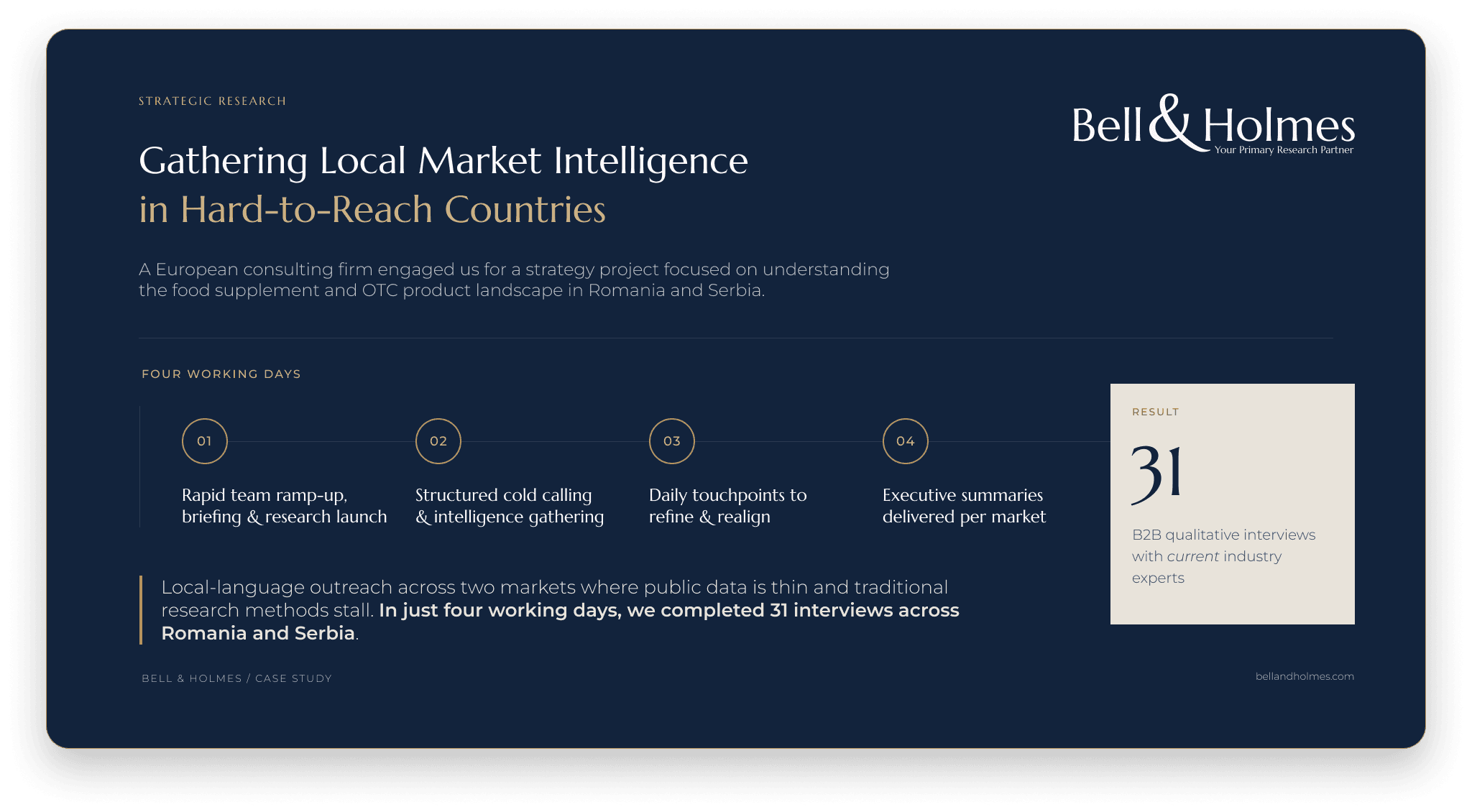
For range, three more. An agricultural CDD covering North America, Europe, and Asia produced 30-plus interviews in five working days, with local-language capability deployed across the US, UK, France, Spain, Italy, and India. An accounting software study across the US, Canada, and multiple European markets ran approximately 400 interviews in 12 working days at 30 to 40 per day, using four internal teams and coordinating across the client's US and UK offices. A four-day engagement in Romania and Serbia delivered 31 interviews in markets where public data was thin and the client had already failed to get traction through conventional channels.
Ramp matters more than any of those totals. Fieldwork typically starts inside 12 to 24 hours and returns first interviews within 48. On a compliance software CDD across six countries, the engagement began as a two-to-three-day feasibility trial and expanded to a full week once it produced, finishing at 23 C-level interviews conducted in local languages across Italy, the Netherlands, France, the UK, the US, and Canada. Starting small is a legitimate way to test whether a market is real before committing the client to it.

One discipline makes the difference between a country list that survives fieldwork and one that gets renegotiated in week two: mark every line in the coverage plan as proven, assumed, or unknown, and price only the proven ones as commitments.
Most scoping does the opposite. A market appears on the list because the target has revenue there, which is a fact about the target and an assumption about the research. Whether respondents in that market are reachable is unknown until someone tests it. Treating those three states as one is how a plan that looked solid in the proposal ends up light on sample.
The test is easy to apply. For each market, ask what evidence exists that the fieldwork will land. Prior projects in that market and sector count as proof. A capability map counts as an assumption. Nothing at all is an unknown, and an unknown should either be tested with a small pilot before the commitment or scoped as a stretch rather than a promise.
Worth naming the bias in that standard, since it runs in our favour. Treating prior projects as the only proof rewards whoever has the longest track record and penalises any supplier entering a market for the first time, including us. It is still the right test, because the alternative is accepting a capability claim at face value. But if a partner has no history in a market and says so plainly, that is a more honest answer than one who quietly counts the market as covered.
This matters more than it sounds because the failure is asymmetric. A market that overdelivers gives you a few extra interviews. A market that fails to yield forces a conversation with the client about why the evidence base is thinner than the proposal said, usually at the point where the findings are being written up.
The scoping checklist: what to confirm before you commit coverage
Run this before the country list goes into the proposal, not after. It is a commercial due diligence checklist for feasibility rather than methodology, and it assumes your thesis and question design are already settled. Copy it into your scoping doc and mark each line P for proven, A for assumed, or U for unknown.
Per market, before committing:
- Estimated respondent population against your actual screening spec, not against the category
- Whether a usable contact list exists, and what happens to the timeline if it does not
- Confirmed in-language interviewing capability available on day one, not recruitable later
- Usable calling window in local business hours, and what that caps daily throughput at
- Any seasonal blackout inside the proposed fieldwork window
- Whether the decisionmaker you need is reachable by phone at all in that market
Across the programme:
- Minimum viable sample per market, agreed before fieldwork rather than negotiated during it
- Which markets you would drop first if the timeline compresses, decided in advance
- Whether your sample will over-index on the two easiest geographies, and what you will do about it
- Named fallback for any market that fails to yield
- Who is verifying that respondents are who they claim to be, and how
Anything marked U at the end of that exercise is not coverage. It is an intention, and it belongs in the proposal as one.

What comes out of that exercise is a coverage-risk register: the specific markets, respondent types, and sample assumptions that could break, held in one place and visible to the client before fieldwork rather than after. It serves the same function on the coverage plan that a red flag review serves on the deal, which is to surface the problems early enough that someone can still act on them.
That last point gets harder as coverage widens, which is exactly when it matters most. Every Bell & Holmes respondent is individually sourced, confirmed in role, and reached through direct outreach, with no open survey links or panel pools that let bots and incentive-farmers in. Every transcript is reviewed by a second person who did not conduct the interview, which catches answers that read as textbook rather than operational. When a valuation moves on what forty people said, the sourcing method behind those forty has to survive the question.
One test to apply to any research partner, including us. Ask which specific markets they have run in your sector in the past year, not how many countries appear on their capability map. Bell & Holmes covers over 140 countries with more than 100 interviewers across 35+ languages. That figure describes where we can field, not a claim that every market has been run for every sector. The projects in this article span roughly a dozen countries between them. The distinction matters when you are the one committing the coverage to a client.

Where the research design needs to match the investment question
Bell & Holmes works across commercial industries and international markets, excluding military and defence research. Difficult markets are not a reason to avoid primary research; they are often the reason to use it.
The question is whether the proposed country mix and respondent specification answer the investment question efficiently. Where revenue is concentrated in one market, depth there is usually more valuable than superficial coverage across several minor geographies. Where the deal budget is limited, a focused test of the most material underwriting assumption may be more valuable than a small sample in every market.
In both cases, this is not a limitation on fieldwork capability. It is a decision to spend the diligence budget where it will move the investment case most
The harder situation is when a market fails feasibility after the client has already been promised it. Three things make that conversation survivable, and all of them depend on having the evidence ready. Bring the reason, specifically: not that the market is difficult, but that the qualifying population is roughly this size, the outreach ran this far, and the yield was this. Bring a substitute of equal analytical value, usually deeper sample in an adjacent market or a different respondent type that answers the same thesis question. And bring it early, while the client can still absorb the change into their own timeline rather than discovering it in the findings. A market reported as unreachable with the reason stated is a defensible outcome. The same market quietly padded with three interviews and presented as coverage is the thing that damages the report.
How the fieldwork layer sits under the advisory layer
Three layers, often collapsed into one in conversation. The acquirer commissions: a private equity fund, a corporate development team, or a lender. The advisor builds and tests the thesis and owns the client relationship. The research partner collects the primary evidence the conclusions rest on.
The third layer goes unnamed in most published explanations of commercial due diligence, which is why it gets scoped last and squeezed first. It is also the layer that decides whether the country list in the proposal was real.
For a deal team, the practical question is which layer you are short of. If the thesis needs testing, that is advisory work. If the thesis is set, the questions are written, and the problem is reaching the target's customers across six markets inside a compressed window, that is a fieldwork problem, and buying it inside a full advisory engagement is usually the more expensive route to it.
Article Q&A
What does multi-market commercial due diligence fieldwork cost?
It scales with sample size and market count far more than with sector complexity. Standalone fieldwork typically costs 15% to 25% per interview of what a traditional expert network charges for comparable access, because you are buying execution rather than roster access and advisory overhead.
How quickly can fieldwork start?
Within 12 to 24 hours where in-country capability already exists, with first interviews back inside 48 hours. If capability has to be built for your market, that becomes a weeks-long answer, which is the single most useful thing to establish during scoping.
What happens when a market fails to yield?
Agree the fallback before fieldwork starts. Options are reallocating sample to adjacent markets, widening the screening spec with the client's agreement, or reporting the market as unreachable with the reason stated. The failure mode is discovering the problem in week two with no agreed response.
How do you verify respondents across markets you cannot see?
Individual sourcing, role confirmation before the interview counts toward sample, direct outreach only, and a second reviewer on every transcript. No open links, no panel pools.
What do you need from us to scope a multi-market programme?
The screening spec, the country list, the fieldwork window, and the minimum viable sample per market. From that we can usually tell you within a day which markets are straightforward, which are hard, and which we would advise against committing to a client.
Scope the countries before you scope the sample. If the revenue is concentrated, buy depth. If it is genuinely spread across markets your team cannot reach directly, feasibility is the question that decides whether the coverage in your proposal is a commitment or a hope.
If you want to see how the work runs before speaking to anyone, the use-case library sets out scope, timeline, and interview counts for a dozen completed programmes. If you have a live deal and a country list, start a scoping conversation and we will tell you what is reachable in your window.
Our services
From hypothesis to investment-ready evidence

One operating standard across all levels of depth, and no vendor change when the question gets harder
Where we operate
Traditional Surveys
Survey Intelligence
How it works →Direct Interviews
See the process →Expert Network
Not sure which approach your project needs? We will point you to the ideal one that still answers it.