16/10/2026
Voice of Customer Research in Due Diligence: What Deal Teams Get Wrong
Voice of customer research in due diligence fails when deal teams only call the target's references. Sample size logic, bias traps and how to fix them.
"The customer list a target hands you is a reference list. It is not a sample."
Most voice of customer research in due diligence goes wrong before the first call is ever placed. Nine working days out from the investment committee (IC), the deal team asks management for a dozen customer contacts, management sends back a dozen satisfied ones, and the memo ends up reporting strong satisfaction. Nobody told an untruth. The damage was done by the sample.
In a deal, voice of customer research has a single job: testing whether the revenue in the model will survive the close. The method is the same one a customer experience team uses to fix a product; the purpose is different, because a deal team uses it to put a price on risk.
Before you blame the interview guide the next time a VoC appendix reads like the target's own website, look at where the respondents came from.
What is voice of customer research?
Voice of customer (VoC) research is a method for capturing, analysing and acting on what customers say, think and feel about a brand, product or service. It combines quantitative channels such as NPS surveys and CRM data with qualitative channels such as in-depth interviews and focus groups, plus indirect sources like support logs and reviews.
The term entered the management literature through Abbie Griffin and John Hauser's 1993 paper "The Voice of the Customer" in Marketing Science. It was written for product teams trying to translate customer needs into engineering requirements, and it argued that one-on-one interviews were at least as effective as focus groups for surfacing those needs.
Diligence trims the toolkit back. Before signing, usable access to the target's CRM, support tickets or survey history is rare, and whatever material does arrive has been packaged by the sell side. The interview is left carrying most of the weight, which is exactly why sourcing matters more than the interview guide.
VoC program vs VoC study: why deal teams need the second
A VoC program is continuous listening run by a company on its own customers: pulse surveys, feedback forms, dashboards, closed-loop follow-up. A VoC study, in contrast, is one-off research built around a single decision and a deadline that will not move. What deal teams need is the study; the program belongs to the business you will own later.
The case for programs is real. Forrester's 2024 US Customer Experience Index found that customer-obsessed organisations reported 41% faster revenue growth, 49% faster profit growth and 51% better customer retention than other firms, although only 3% of companies met Forrester's definition. That makes a strong case for building a VoC program inside a portfolio company after close.
During diligence, treat the target's program data with caution. It arrives curated by the people selling the asset.
For corporate development teams there is a useful bridge. A well-run diligence study becomes the baseline for the acquirer's own program after close, so the first post-merger survey has something to be compared against.
Voice of customer vs customer satisfaction survey: which holds up at investment committee?
A customer satisfaction survey reports how current customers feel today; voice of customer research in diligence reports what those customers are likely to do next, whether that is renew, expand, renegotiate or leave. The first gives you a score. The second gives you the reasons an investment committee will interrogate.
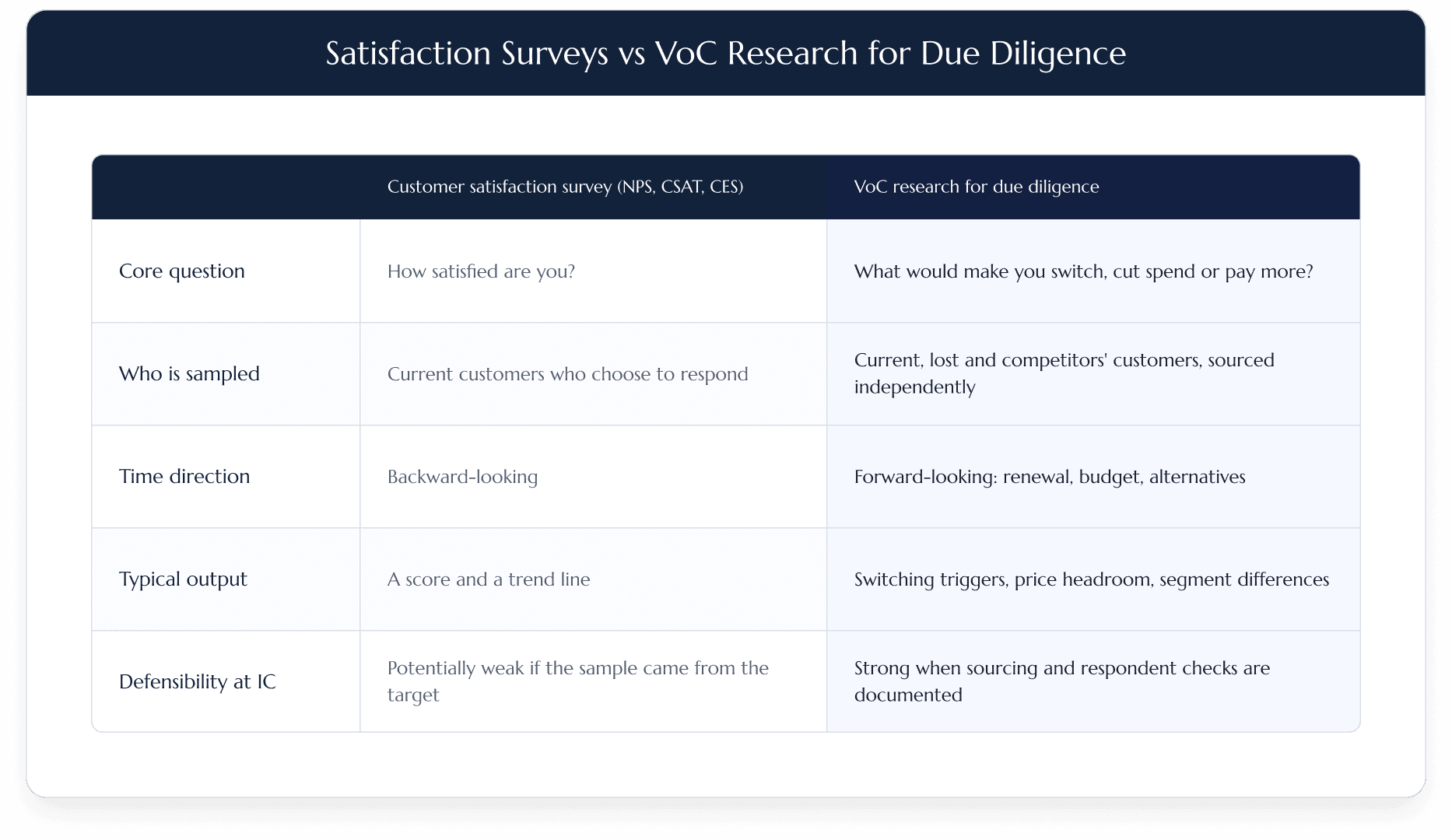
The three common satisfaction metrics each measure something narrow. Net Promoter Score asks how likely a customer is to recommend, CSAT asks about satisfaction with an interaction or product, and Customer Effort Score asks how hard something was to get done.
All three are useful inside a business. None of them, on its own, tells a buyer whether pricing power exists.
Six mistakes deal teams make with VoC
Most failed VoC work in diligence breaks at the sampling and framing stage, long before anyone analyses a transcript. These are the six errors we see most often, roughly in order of how much damage they do.
1. Calling only the reference list. References are chosen by management, so the bias is in place before the first question is asked. Interview them, but label them as a separate cell (one customer group, current mid-market accounts for example) and never treat them as a stand-in for the wider customer base. For the consulting case team, the same rule applies to any list the client forwards.
2. Skipping lost customers. How many left is what the churn table tells you. Why they left, and whether the reason is fixable under new ownership, is something only the people who left can explain.
3. Ignoring the competitor's customers. Where the target loses deals is a question for the buyers who chose someone else. Their answers test the moat from the outside.
4. Asking about satisfaction instead of switching cost. "Are you happy?" invites a polite answer. "What would leaving cost you in time, money and risk?" is the question that exposes lock-in. How to phrase and probe these questions is what our practitioner's question template covers.
5. Treating one segment or one role as the whole market. Weak mid-market traction can hide behind strong enterprise accounts, so any segment the growth plan depends on needs interviews of its own. In B2B, several people also sit on the path to purchase: the signer, the daily user and whoever evaluated the alternatives. Interviewing more than one of those people is what mapping that buying centre means.
6. Running VoC after the thesis is set. Research run only to confirm tends to find whatever it was designed to find. Customer work has to happen early enough that it can still change the answer, a point we develop at length in why confirmatory-only CDD now loses deals.
Most of these fixes run into the same wall before signing: you usually can't call the target's customers and mention the deal. The workaround is category-level research. Ask buyers how they choose suppliers in the space, who they use and what would make them switch, and the target comes up unprompted alongside its competitors. That framing also reaches lost and competitor customers without breaking an NDA.
There is a quieter failure underneath all six: not knowing who was actually on the call. A VoC finding is only as good as the evidence that each respondent matched the profile you agreed.
Reference calls still have a job, to be fair. When a target has 15 customers in total, management's references may be a third of the base, and skipping them would be odd. The mistake is presenting them as the market.
How many VoC interviews are enough?
For a homogeneous customer segment, the studies below put the range somewhere between roughly nine and 30 in-depth interviews, depending on whether the main themes are enough or their full meaning is needed. Diligence totals then depend on how many segments the thesis rests on, whether lost and competitor customers are included, and whether the investment case needs a number rather than a set of reasons.
The research base is consistent. Griffin and Hauser's data suggested that 20-30 interviews per homogeneous segment identify 90-95% of customer needs, and that 20 customers surfaced over 90% of the needs that 30 produced. Guest, Bunce and Johnson (2006) found thematic saturation within 12 interviews. Hennink, Kaiser and Marconi (2017) separated "code saturation" at around nine interviews from "meaning saturation" at 16-24, and a 2022 review of 23 studies by Hennink and Kaiser put saturation at 9-17.
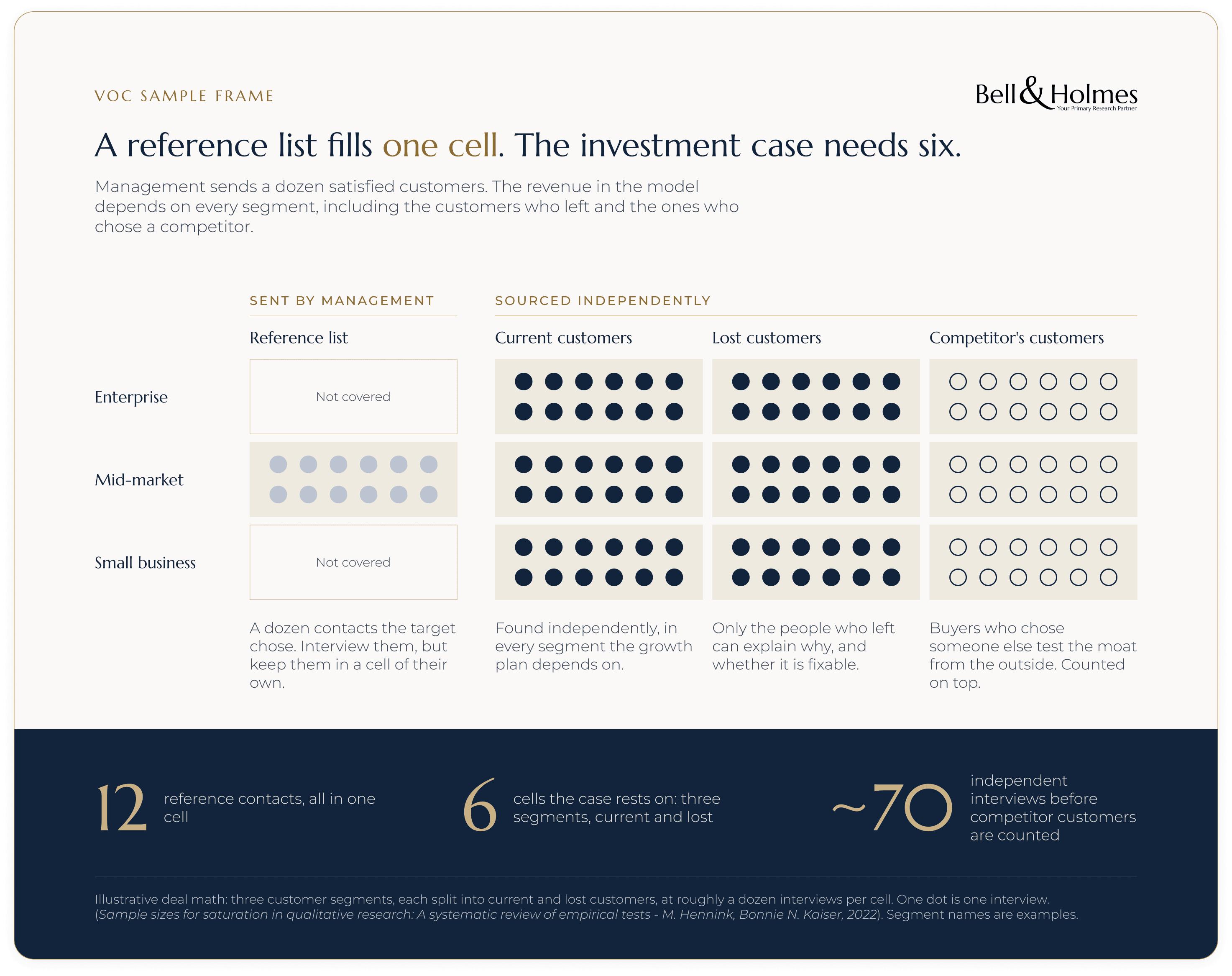
Deal math multiplies those ranges quickly. Three customer segments, each split into current and lost customers, at roughly a dozen interviews per cell, already comes to around 70 conversations before competitor customers are counted. Consider that an illustration.
Two Bell & Holmes projects show the range. A European private equity firm evaluating an enterprise data platform needed 16 interviews with current users and implementation partners, completed in three working days, because the user base was narrow and the questions were specific. An accounting software CDD across North America and Europe ran to roughly 400 interviews in 12 working days, because switching intent and pricing had to be read by firm size and country.
The practical stopping rule is straightforward: once new conversations inside a cell stop producing new themes, move what is left of the budget to the cell where evidence is still thin. Daily results put that moment on the table while there is still time to do something about it.
VoC research for private equity and corporate M&A: how the brief changes
Same method, different question. A private equity team asks whether this revenue will hold and grow under its ownership. A corporate development team asks what happens to customers when two businesses combine, and that changes who you interview and what you ask.
For PE, the brief centres on retention, pricing power, customer concentration and expansion potential. The questions probe renewal intent, recent price increases, budget direction and the alternatives a customer would consider.
Corporate M&A adds overlap and cross-sell to the brief. What share of the target's customers already buys from the acquirer, and would they consolidate or diversify? Because the deal must stay undisclosed, cross-sell appetite has to be tested blind.
Change-of-ownership risk is the third addition. Some customers picked the target precisely for its independence, and an acquisition can set off the very switching it was meant to prevent.
Longer corporate approval cycles help on this front: a short customer sprint ahead of a formal process can show whether a target merits a full diligence effort at all.
The sourcing rule from the six mistakes applies with extra force. Overlap customers have to be found independently, because the acquirer's own account managers will introduce the friendly ones.

What independent sourcing looks like when the client list fails
In one US trucking commercial diligence, a Big 3 consultancy needed to understand how owner-operators and individual drivers used third-party administrative, legal and benefit services. The initial client data had gaps that made it unsuitable for outreach.
The best example we can give of VoC done properly started with a customer list that did not work. It proves the sourcing half of the argument: when a list fails or flatters, the market is still reachable. The approach that followed has become our default: The work followed a simple operating sequence: calibrate the profile, source the market independently, check respondent quality every day and re-aim outreach as early findings emerge.
How owner-operators and individual drivers use third-party providers for administrative, legal and benefit-related services was what a Big 3 consultancy needed to understand for a commercial due diligence in US trucking. That population is fragmented and mobile, and standard B2B channels rarely reach it.
The initial client data had gaps that made it unusable. Our team calibrated the respondent profile with the case team, then built its own contact pool from internal tools and alternative data sources, and switched to individual-level outreach suited to people who are often on the road. Daily alignment calls reviewed progress, validated respondent quality and adjusted targeting.
The result was 105 targeted interviews in seven working days, and the client reached its target number of interviews in the states that mattered. The partner's feedback: "NPS 10 and 5/5 on quality of insights."
Speed mattered because the case team had an update going to the client that same week. First interviews inside 48 hours of kick-off is our standard, and here that pace outpaced the client's traditional channels, which had trouble reaching this group at all. Every daily call validated respondent quality, and a second-reviewer quality check stands behind every Bell & Holmes interview.
Sourcing mattered most of all. Expert networks supply people who opted in to talk; panels supply people who opted in to answer. Owner-operator truckers sit in neither, which left outreach by trained research consultants as the only route.
The same model runs in 35+ languages across 140+ countries, which matters on cross-border deals where a translation layer would strip the nuance out of a customer's answer. On a compliance-software CDD, it delivered 23 senior interviews across six countries in five working days.

Winning vs walking away
A VoC study built on the reference list will almost always support the deal. One built on the market will sometimes tell you to walk away, which is the only reason to run it.
See how the trucking CDD was sourced when the client list failed, or talk to Bell & Holmes about scoping your next study.
Article Q&A
What is a good VoC score? There is no single "VoC score". The phrase usually refers to Net Promoter Score, which runs from -100 to +100, and what counts as good varies widely by industry. In diligence, the distribution of scores and the reasons behind them matter more than the headline number.

What is VoC in Six Sigma? In Six Sigma, voice of the customer is the input to quality improvement. Customer statements are translated into measurable "critical-to-quality" (CTQ) requirements, usually through a CTQ tree, so that process performance can be measured against what customers actually need.
Can voice of customer research use synthetic respondents? Not for decisions that carry deal risk. Synthetic respondents reproduce patterns from existing data, so they cannot tell you how a specific target's customers will react to a price rise or an acquisition. We cover the limits in how AI is mimicking customers, experts and employees.
Our services
From hypothesis to investment-ready evidence

One operating standard across all levels of depth, and no vendor change when the question gets harder
Where we operate
Traditional Surveys
Survey Intelligence
How it works →Direct Interviews
See the process →Expert Network
Not sure which approach your project needs? We will point you to the ideal one that still answers it.