20/11/2026
How Do PE Firms Run Commercial Due Diligence Before LOI Expiration
A practical CDD timeline for PE deal teams facing LOI expiration, with five- and six-day research examples, daily decision gates and scope trade-offs.
PE firms run commercial due diligence (CDD) before the letter of intent (LOI) expires by working backwards from the investment committee (IC) date. They test only the assumptions that could change the deal, and they call the work complete when it meets an agreed scope and evidence standard. A fast first answer is useful. Calling it finished diligence is where teams get into trouble.
If you have signed an LOI on Friday with an IC meeting booked for the following week, the research plan cannot begin with a long questionnaire. It begins with the assumptions that would make you reprice, pause or walk away.
What deadline actually matters before LOI expiration?
Three dates shape the plan: the contractual expiry confirmed by counsel, the internal IC meeting and the evidence cutoff. Work backwards from the decision that needs the research. The signed terms determine what exclusivity restricts and when it ends; the committee date may require usable findings earlier.
The signed documents set the contractual position. The internal decision date sets when CDD evidence has to be usable. A final report delivered after IC may be thorough and still irrelevant. A two-page readout delivered the morning before IC can matter more, provided it answers the right question and states its limits.
Read the LOI with transaction counsel before promising a delivery date. Offer validity and exclusivity are not interchangeable, and neither sets the deadline for every workstream. Financing, legal review, regulatory approvals and seller responsiveness can create their own critical paths.
Goodwin's Private Equity Deal Database shows a sharp rise in longer exclusivity periods. About 6 percent of deals with exclusivity ran 61 days or more in 2021, against nearly 40 percent in 2022. Most of the 2022 deals in that group ran at least 76 days (Goodwin, Durations in M&A Exclusivity Periods Increased Significantly Since 2021, May 2023). The figures cover those two years only and do not show the current position.
Axial, a deal platform serving the lower middle market, adds a 2025 view (Axial, Dead Deal Report: Unpacking 2025's Broken LOIs). Its analysis of 75 unsuccessful transactions found that private equity buyers had been under exclusivity for an average of 106 days before the deal broke. Findings from diligence outside quality-of-earnings (QoE) work caused 25.3 percent of the failures, up from 19.1 percent in 2023.
The sample comes from one platform, so read it as directional. Axial also notes that many of these findings surfaced only after months of work.
For the commercial workstream, write down four timestamps:
- The internal IC or partner meeting.
- The last practical date for a findings readout.
- The date by which new primary evidence must stop entering the analysis.
- Any contractual expiry or exclusivity date confirmed by counsel.
Set an evidence cutoff before the recommendation is written. Otherwise, new interviews can keep changing the analysis while the team is trying to reach a decision.
How long does commercial due diligence take?
Length follows the scope and the decision date, rather than a fixed number of weeks. B&H case examples include research delivered in three, five and six working days, alongside fieldwork projects lasting 12 and 20 days. These examples describe specific assignments, not a standard duration for a complete CDD workstream.
Three different deliverables get called the same thing, and treating them as one creates commitments nobody can keep.
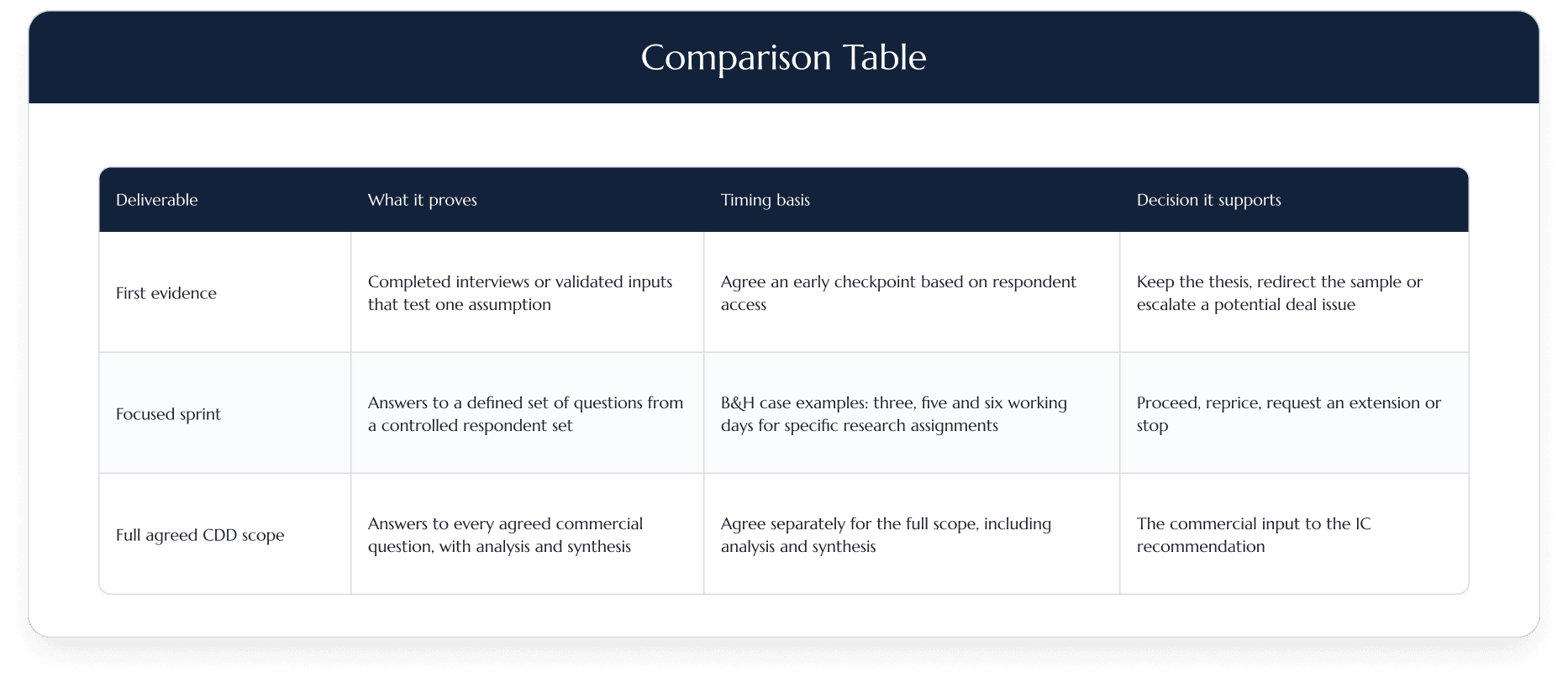
Completion depends on the scope, not on the label. A focused sprint is a completed exercise once its agreed questions meet the evidence standard, which is why a narrow scope can finish in a week. First evidence is a decision input rather than a completed exercise, because it tests one assumption. The third row adds the analysis and synthesis required by the agreed commercial scope.
Define completion in the scope before fieldwork starts. The scope names the questions, the markets, the minimum interviews per respondent group, how respondents were sourced, and what counts as confirmation, contradiction or an unresolved answer.
B&H case examples show the scope behind those durations:
- Fire departments, US public sector: six working days and about 60 interviews with decision-makers across departments of varying size.
- Agriculture, North America, Europe and Asia: five working days and more than 30 interviews with farm owners, agronomists and distributor sales leads.
- Enterprise data platform, European PE firm: three working days and 16 interviews with platform users and implementation partners in North America and Europe.
- Accounting software, North America and Europe: 12 days and about 400 interviews with decision-makers at accounting firms.
- County financial software, US public sector: 20 days and about 320 interviews with county-level stakeholders.
The 12- and 20-day examples concern fieldwork. They do not establish how long a complete commercial workstream, including analysis and synthesis, would take.
Treat a 48 to 72-hour window as an early checkpoint, subject to respondent access. It may reveal recruitment problems or an initial contradiction, but the elapsed time alone says nothing about coverage. State the interview count, respondent types and markets beside the findings, and identify questions that still rest on a single account.
The three-working-day data platform project fits that pattern. It supports a focused sprint. It does not support full CDD in 48 hours, and 16 interviews would not size a market.
How should a deal team scope CDD for a compressed timeline?
Scope backwards from the investment thesis. Name the few assumptions that carry the deal, give each one an evidence test and a decision consequence, and drop any question that cannot change price, structure, timing or the recommendation. Agree the minimum sample and who can change the scope before fieldwork starts.
A useful scope document answers five questions:
- Which assumption is most likely to break the thesis?
- Who outside the target can provide direct evidence on it?
- What would count as confirmation, contradiction or an unresolved answer?
- Which market or respondent group is essential, and which is optional?
- Who has authority to change the scope when the evidence moves?
Set the minimum viable sample at this stage. Define the respondent mix, the geographies that matter and the level of contradiction that would block a clean recommendation. Where the client can share customer data, ask for it before recruitment starts, since churn by segment or customer size shows which accounts to prioritise.
Narrowing the work speeds the decision but leaves less material for value-creation planning after close. A sprint built to test customer retention may not show how to build the next sales channel. Record that gap in the readout so the final presentation does not imply wider coverage.
For the fieldwork mechanics, see how to run primary research under compressed PE timelines. This article covers the deal clock: what happens each day and which decision follows.
Why do management-supplied references need independent sourcing?
Management-selected references reflect the accounts management chose to put forward. Independent sourcing can broaden that view, but it does not automatically make a sample representative. Assess which customer groups the reference list covers, which are absent and whether the research can reach them within the permitted scope.
Do not assume the reference list includes former customers or buyers who chose a competitor. Where those perspectives matter, treat their absence as a coverage gap rather than evidence that the issue does not exist.
- Independent sourcing. On a six-working-day strategy project, the client asked for more than half of 48 interviews with users of one vendor. No contact list existed, so the team sourced those respondents independently.
- Independent recruitment still needs a clear sample definition. Check which segments the completed interviews cover and report any gaps that could affect the recommendation.

What does a six-working-day CDD plan look like?
This illustrative six-working-day plan puts desk research and sourcing on day one, an early evidence review on day two and follow-up research on days three and four. It reserves day five for analysis and day six for the readout. It is a planning model, not a reconstruction of a client project or a delivery commitment.
Day 1: fix the questions and start the parallel tracks. Review the thesis and management forecast while the deal team reviews the data-room documents, and turn both into a short hypothesis register. Request any customer data the client can share, and start sourcing at the same time.
Treat sourcing as the critical path. In a single-market brief that means lists, gatekeepers and screening. In a multi-country brief, the number of markets usually decides whether the window holds, because each country adds its own business hours, languages, contact routes and eligibility rules. Those run in parallel only if someone starts them on day one.
The day-one output is an agreed set of questions, respondent types, geographies and decision thresholds. The day-one decision is subtractive: which workstream comes out because it cannot affect the deal? If the market definition is still disputed, resolve it before anyone produces a precise market-size estimate.
Day 2: test the first evidence and correct the setup. Review the earliest interviews and desk findings against the hypothesis register, and look for signs that the respondent specification, the questionnaire or the market definition is wrong. Change the setup now, while correction is still cheap.
The first readout separates observed evidence from interpretation and names what has not been tested. The decision is to continue as planned, redirect the sample or escalate a potential deal issue at once.
Days 3 and 4: chase contradictions as well as volume. Add interviews across the customer, operator, channel or competitor groups that can explain the early pattern. Compare what different respondent types say about switching, pricing and substitutes. Where a market model is in scope, check its inputs against what participants report.
Keep a contradiction log. Three customers praising a product and two describing an active switch are a prompt to find out how those accounts differ by size, region, tenure or use case.
By the end of day four, the deal team should know which assumptions have support, which have failed and which remain thin. That is the point to decide whether more fieldwork can change the recommendation. Extra interviews with the same profile may add comfort without adding information.
Day 5: freeze the evidence and test the recommendation. Stop adding material to the main analysis unless it answers a named uncertainty. Map each material finding to the investment model, proposed terms or open-risk register, and separate a verified red flag from a concern that needs more work.
The decision is to proceed, reprice, request an extension or stop. Proceeding with open questions is also a valid decision, provided the questions stay visible and the IC understands their weight.
Day 6: deliver the decision readout. Present findings by thesis question, state the sample, coverage and limitations beside each conclusion, and show which model assumption or deal term changed because of the evidence.
If the LOI expires on day four, narrow the question set or negotiate the timeline. Two days of calls do not answer a six-day brief.
Why does market analytics slow compressed CDD?
Analytics slows compressed CDD when numbers arrive before the market is defined. Published sources use different geographies, customer groups and revenue pools, so combining them can produce a precise total for the wrong market. Settle the market boundary first, then size it.
The failure often starts with the denominator. Is the target selling to every fire department, or only departments of a given size with a particular procurement process? Those choices decide which respondents and data points belong in the analysis.
Primary research helps when it tests the boundary as well as the estimate. Buyers and operators can say which products they treat as substitutes, who controls the budget and where a reported category stops matching purchasing behaviour.
Interviews cannot turn a small, convenient sample into a reliable market share. Use them to challenge model inputs and expose missing segments, and keep the uncertainty visible in the model. The B&H guide to red flags in primary research during due diligence covers these failure modes in more detail.
What do completed projects show about compressed CDD?
Compressed CDD depends on daily scope control as much as on interview capacity. Completed projects show what happens when targeting, questions and outputs can change while the deal team still has time to act. Interview totals only mean something once the reader knows who answered and what those answers changed.
On the fire department project, the client refined regions, department sizes and lines of inquiry during fieldwork. Daily alignment calls made those changes usable, and the team supplied interview summaries covering satisfaction metrics and vendor perceptions.
The agriculture client could not attend regular calls, so detailed daily written summaries carried the decision cadence. The reporting format has to fit the people making the decision.
When assessing interview evidence, ask how respondents were recruited, what qualified them to answer and how their accounts were checked. Record any limits on verification beside the findings. An interview count alone does not establish that the sample fits the investment question.
These cases also show why "60 interviews" is an incomplete brief on its own. Ask what the respondents were qualified to answer, which markets they covered and which findings were strong enough to use. Volume without that context is an operations metric.

How do the main sourcing options compare?
Compare sourcing options against the actual brief: who must answer, how quickly they can be reached, what language the work requires and how eligibility will be checked. The table sets out questions and trade-offs rather than provider rankings. Verification and coverage depend on the agreed setup, not just the method's label.
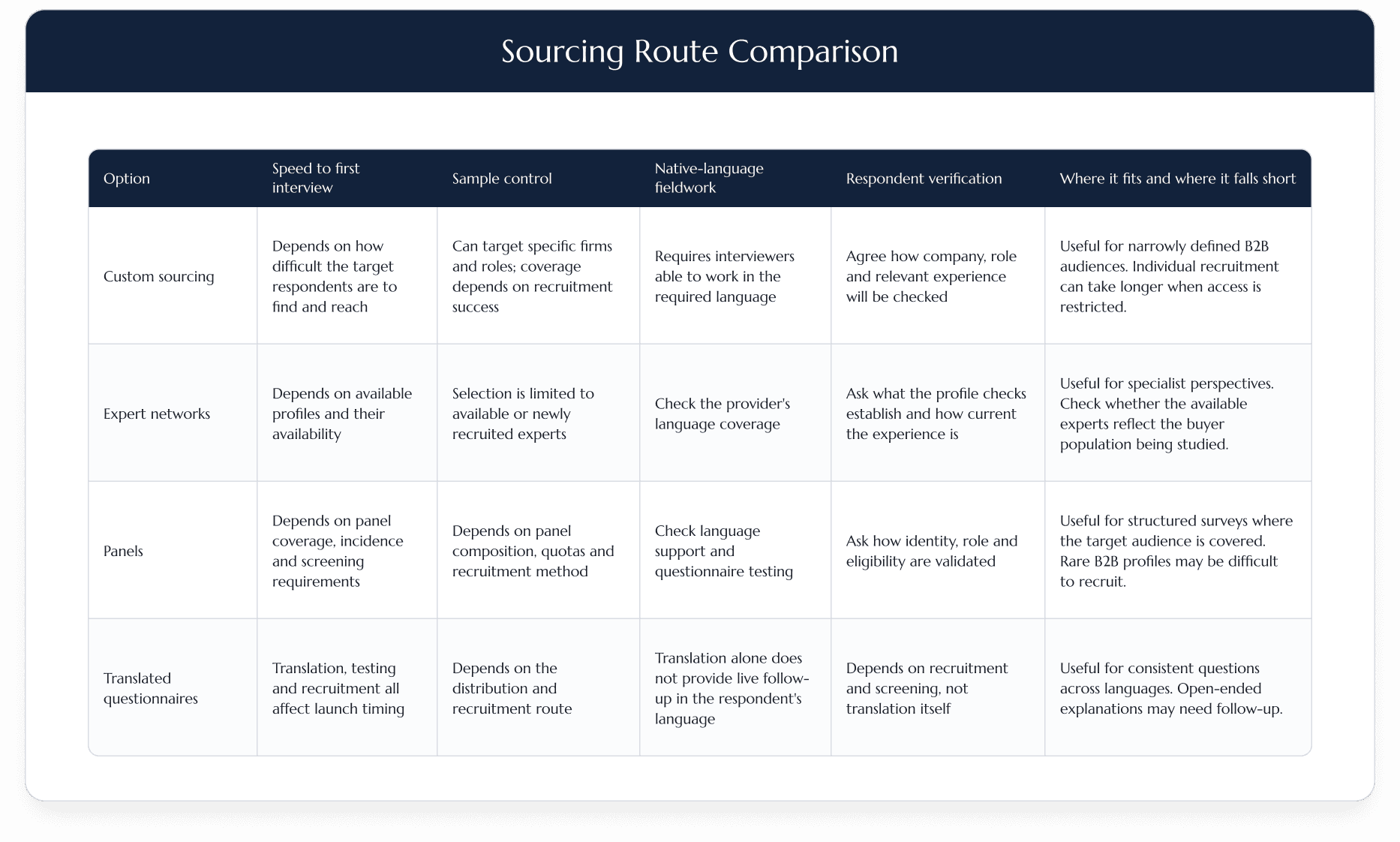
These are considerations for selecting a method, not assessments of individual providers. A scope can combine approaches. Keep the recruitment route visible so readers can judge which population each finding represents.
Article Q&A
When should a deal team not compress CDD?
Do not compress CDD when the remaining work would change the decision but cannot be done responsibly inside the window. Typical cases are an unreachable respondent group, an unresolved market definition or a customer concentration question that needs wider account coverage. In those cases, narrow the scope or extend the timeline.
Some questions sit outside primary research. Regulatory approvals, contract assignability and tax exposure need the relevant advisers, and customer interviews can surface a concern without giving the legal conclusion.
A compressed screen can create false confidence once its limits disappear from the presentation. A handful of cooperative customers may be unrepresentative, and a market with few accessible experts may need more secondary evidence and an explicit residual-risk note. If the evidence cannot support the intended recommendation, the right output is a narrower recommendation or a request for more time.
Parallel markets and respondent tracks protect a deadline, but they add coordination and quality-control load. Buying speed without a defined decision is an expensive way to produce transcripts.

Can commercial due diligence be finished in a week?
A narrow research scope may fit a week if respondent access and the required analysis allow it. B&H's five- and six-working-day case examples demonstrate specific research assignments, not completion of every commercial workstream. Define the questions, deliverables and evidence standard before deciding whether a one-week deadline is feasible.
How fast can commercial due diligence be done?
Separate the date of the first interview from the date of the final decision readout. Timing depends on respondent access, screening requirements and the analysis in scope. B&H's three-working-day data-platform assignment is one project example, not a guaranteed turnaround for another brief.
What should be finished before LOI expiration?
Finished means each agreed question has been answered to the evidence standard in the scope. Any finding that affects price, structure or the decision to proceed should reach the decision-maker before the contractual or internal deadline. Counsel should confirm what the LOI itself requires.
What is the difference between a red-flag review and full CDD?
A red-flag review tests the issues most likely to stop or reshape the transaction. Full CDD covers the wider agreed assessment of the market, customers, competitors and growth plan. A red-flag review can run before or alongside fuller work, but its narrower output should be labelled as such.
What should you bring to a scoping call?
Bring the LOI dates, investment thesis, target geographies and respondent requirements to a scoping call with Bell & Holmes. Use the discussion to agree the research questions and assess feasibility before committing to a deadline. Specify what the first readout needs to answer and what would remain outside the scope.
If you want to see how this plays out in the field, read how a six-working-day CDD project with US fire departments actually ran.
Our services
From hypothesis to investment-ready evidence

One operating standard across all levels of depth, and no vendor change when the question gets harder
Where we operate
Traditional Surveys
Survey Intelligence
How it works →Direct Interviews
See the process →Expert Network
Not sure which approach your project needs? We will point you to the ideal one that still answers it.