08/05/2026
Red Flags That Only Surface Through Primary Research in Due Diligence
Discover how primary B2B research uncovers red flags in due diligence, ensuring your investments are sound and well-informed. Learn more now!
Summary of Key Takeaways
- Primary research surfaces red flags that data rooms are structurally incapable of revealing
- Customer churn risk, revenue quality signals, and competitive dynamics are all primary research findings
- B2B due diligence research requires active outreach to senior, hard-to-reach respondents - not panel databases
- The right b2b market research agency can launch within 24 hours and deliver findings within a standard CDD timeline
- Secondary research confirms the known narrative; primary research tests whether that narrative is true

Most acquisition teams enter due diligence with a stack of analyst reports, management presentations, and industry databases. The problem: the target company curated all of it. Secondary data tells you the story the seller wants to be told. B2B research - the direct collection of market intelligence from buyers, competitors, and industry participants - tells you what the market actually thinks. That gap is where deals go wrong.
This article breaks down the specific red flags that never appear in a data room, why B2B market research operates differently in a CDD context, and how to engage the right B2B market research agency to surface deal-critical intelligence before it is too late.
Understanding Primary Research
Primary market research is the direct collection of original data from market participants - customers, competitors, distributors, or former employees - through interviews, targeted surveys, or expert calls. It produces evidence no secondary source can replicate because it is sourced fresh, in context, and for the specific decision at hand.
In B2B settings, this matters more than it does in consumer work. The universe of relevant voices is small. Each interview carries more signal. And in due diligence, where the margin for error is measured in deal multiples, the difference between primary and secondary data is not methodological - it is financial. A single candid interview with a current customer of an acquisition target can surface information that took the seller years to obscure in their data room.
Primary research is time-intensive. In high-stakes investment decisions, that cost is measured against what a missed red flag does to deal returns.
How Primary Research Differs from Secondary Research
Secondary research - analyst reports, company filings, industry databases - is fast to access and easy to deploy. Its structural blind spot runs deeper than selection bias: a documented share of syndicated commercial reports contain fabricated market-sizing with no verifiable primary source behind the figure. It is exactly this blind spot that has pushed primary research into the default diligence layer on B2B deals.
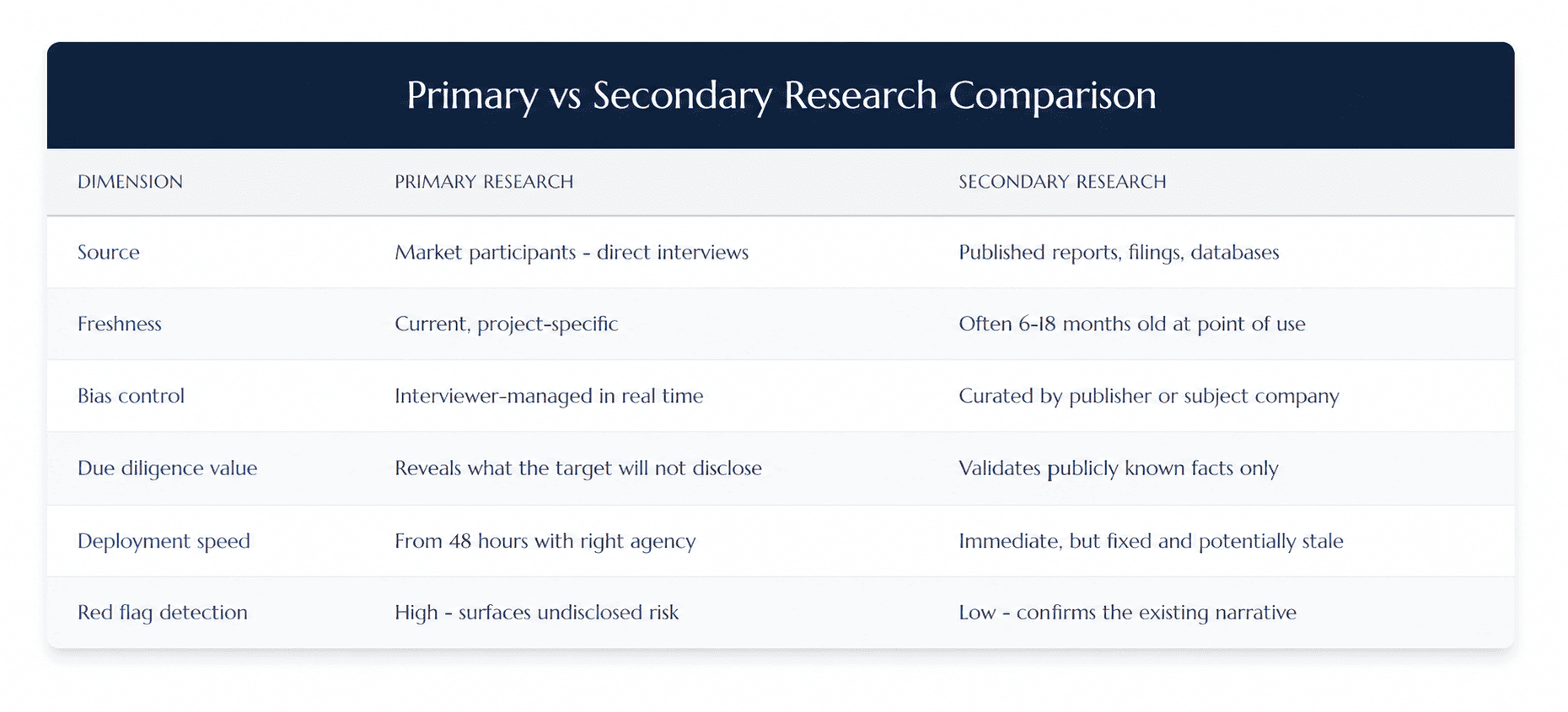
The Role of B2B Market Research in Due Diligence
B2B market research is the systematic process of gathering intelligence about a business market - its buyers, competitors, suppliers, and structural dynamics - to inform strategic decisions. For marketing teams validating brand positioning, product managers running concept tests, or sales teams mapping buyer journeys, it is the standard instrument for reducing commercial uncertainty before committing resources. In due diligence, the objective narrows sharply: you are not studying a market to enter it. You are stress-testing the deal thesis against what the market actually knows.
That distinction changes everything about how research should be structured. Standard b2b market research for product launches or GTM strategy has months to iterate. CDD runs on days. The research design, outreach, and analysis must compress into a window that most generalist research providers were not built to serve.
What is B2B market research in a CDD context? It answers four questions that secondary sources cannot: Is the target's stated market position real? Are customers genuinely satisfied and sticky? Are competitors more threatening than disclosed? And are there structural shifts in the market that the target has already factored into its exit timing?

Key Differences Between B2B and B2C Market Research in CDD
Enterprise stakeholders are rarely accessible through consumer-style panels or open survey links. According to Corporate Visions, enterprise buying groups now average 10 to 11 stakeholders, often spanning multiple functions and seniority levels. In diligence contexts, reaching these stakeholders within tight timelines requires direct outreach, credible positioning, and researchers who can navigate technical conversations.
B2C research methods - online panels, broad surveys, social listening - fail entirely here. The target's buyers are too few and too senior to sample casually. Each conversation is high-value and non-replaceable. Social listening platforms and AI-moderated research tools generate useful signals for brand tracking and go-to-market strategy. They surface nothing about what a target's key accounts are choosing not to disclose. That gap is what CDD exists to close.
Common Red Flags Identified by Primary Research
Three categories emerge most reliably in commercial due diligence: financial reporting inconsistencies, customer sentiment problems, and market-positioning gaps. The interview design matters: use these open-ended due-diligence questions to get beyond a respondent’s first, rehearsed answer.
Inconsistencies in Financial Reporting
Financial red flags that primary research uncovers do not show up in audited accounts. They surface in what customers say about pricing. When interview data reveals that the target's buyers are receiving undisclosed discounts, delayed renewal conversations, or unusual payment flexibility, that pattern points to revenue quality issues no P&L statement will flag directly.
Interviews with former sales personnel - reachable through active cold outreach, not panel databases - can confirm whether booked revenue reflects genuine demand or front-loaded recognition. These conversations only happen when a researcher reaches out independently and builds enough trust for candid disclosure.
Customer Sentiment and Perception Issues
Customer churn risk is one of the hardest things to see in a data room. NPS scores and contract lists tell you who the accounts are. They do not tell you whether those accounts are running active win/loss comparisons with competitors, under-using the product, or staying only because switching costs are prohibitively high. A score with no reasoning recorded behind it cannot answer that. Verified, disclosed-provenance interviews can, because you see the company and role of the person whose answer drove the number.
Five to ten direct customer interviews can shift a deal thesis entirely - provided they happen early enough in the commercial due diligence process to still change the price. In one Bell & Holmes commercial due diligence engagement - a CDD project on a niche compliance software provider serving hedge funds and asset managers across Europe and North America - primary interviews surfaced critical feedback on product limitations and competitive alternatives that appeared nowhere in the management presentation. Those findings directly shaped the client's advisory recommendations before deal close.
Market Position and Competitor Analysis Gaps
Targets present competitive analysis that positions them favorably. Primary research, structured as competitive landscape research, tests that picture against what competitors and market participants actually say. A customer who uses three products side by side is a better source of competitive intelligence than any market map the target has built. Market sizing estimates in a data room reflect what the target chose to measure. Buyers and channel participants describe how the addressable market is actually shifting - including contraction the seller's own analysis did not capture.
Red flags in this category include: competitors the target did not mention who are present in key accounts; product gaps that customers have already started compensating for; and win-rate patterns that suggest the target is losing ground in new business. None of these appear in management presentations. All of them surface in direct interviews.

Case Studies: Real-World Examples of Red Flags
Two Bell & Holmes engagements - one for a European PE firm, one commissioned by a Big 3 consultancy - show what primary b2b research surfaces when deployed under deal pressure.
Case Study 1: Customer Evaluation That Reshaped a PE Firm's Position
A European private equity firm engaged Bell & Holmes to evaluate an enterprise data platform used by large corporations in financial services, healthcare, and retail to manage high volumes of information. The firm needed direct insight from current users and implementation partners. No usable contact list existed, and the required audience - heads of data and IT directors at enterprise organizations - had not been reached through the firm's existing sourcing channels.
Bell & Holmes independently identified and engaged 16 qualified decision-makers across North America and Europe - including Scandinavian and German-speaking markets - in three working days. Interviews covered adoption rationale, pricing dynamics, switching behaviour, deployment preferences, and how users evaluated the platform against competing solutions.
The research gave the PE firm visibility into dimensions their secondary analysis had not reached: how enterprise customers compared the platform to alternatives, where pricing pressure was building, and what factors were driving switching decisions. Those findings shaped the firm's strategic evaluation of the product and its competitive standing across global markets.
Case Study 2: CDD That Changed the Deal Terms
A Big 3 consultancy commissioned b2b market research from Bell & Holmes for a client evaluating a niche compliance software provider. The target served hedge funds and asset managers across Europe and North America - a hard-to-reach audience with no viable panel equivalent.
Bell & Holmes completed 23 in-depth interviews with C-level executives and compliance heads across the UK, US, Canada, France, Italy, and the Netherlands in five working days. The research mapped adoption patterns, pricing benchmarks, decision-making dynamics, and competitive perceptions - data the secondary sources had not captured and the management team had not offered.
The findings gave the deal team a negotiating position grounded in what customers actually valued. The client's assessment: depth and quality rated 5 out of 5.
Choosing the Right B2B Market Research Agencies
Not all b2b market research companies are equipped for due diligence work. Most generalist b2b market research agencies do excellent work in their lane: brand health tracking, usage-and-attitude studies, concept testing, market sizing, and focus group research. These methodologies take two to four weeks to design, field, and analyze. That timeline suits strategic planning. It does not fit inside a 10-day CDD window, and agencies optimized for it are not the right partner for a live transaction. The selection criteria matter as much as the decision to commission research at all.
Active sourcing capability. The most important requirement. Can the agency directly reach the specific roles you need, such as procurement directors, operations heads, or current industry operators, without relying on opt in panels? Panel-based research produces respondents who signed up to be surveyed. Decision relevant diligence insight often comes from stakeholders who had no reason to expect the outreach.
Speed of deployment. A b2b market research agency that needs two weeks to mobilise is not compatible with a 10-14 day CDD window. The benchmark to require is a 24-48 hour ramp-up, with interviews starting within the first 48 hours of project kick-off. Agencies that cannot commit to this are built for a different type of work.
Global reach with verified linguistic coverage. Acquisition targets rarely operate in a single market. An agency covering 140+ countries in 35+ languages is not a preference for cross-border deals - it is a structural requirement. Language capability affects who can be reached and how candid those conversations are.
Benefits of Engaging B2B Market Research Agencies for Due Diligence
The core benefit is straightforward: decision-grade data before you are bound by the deal.
An experienced b2b market research agency operating in the CDD space does not just collect interviews. It identifies patterns across dozens of conversations in a compressed window - the kind of pattern recognition that generalist platforms and in-house research teams rarely have the depth to replicate under deal pressure.
The operational benefit is equally clear. An investment team running a compressed diligence process does not have the bandwidth to independently source, screen, and interview 20-30 market participants. Outsourcing to a specialist agency - while retaining strategic framing in-house - is how the best PE teams close information gaps without extending timelines.

Conclusion
Due diligence that relies exclusively on secondary data is not due diligence. It is risk acceptance dressed as process. Primary b2b research is the only method that accesses the information a target has no reason to volunteer: what customers actually think, what competitors have observed, and where the market is already moving.
Before the next deal process, define where primary research fits in the CDD workstream - not as a supplementary task after management presentations, but as a parallel track running from day one.
Identify the customer and competitive interview targets early. Align with your b2b market research agency on scope before the data room opens, not after. The deals that go wrong are rarely missing data. They are missing the right conversations.
Partner with Bell & Holmes for primary B2B research that delivers decision-grade intelligence within 48-72 hours - across 140+ countries and 35+ languages.
Our services
From hypothesis to investment-ready evidence

One operating standard across all levels of depth, and no vendor change when the question gets harder
Where we operate
Traditional Surveys
Survey Intelligence
How it works →Direct Interviews
See the process →Expert Network
Not sure which approach your project needs? We will point you to the ideal one that still answers it.