17/04/2026
What Decision-Grade Research Looks Like in 2026 and Beyond
Discover what B2B market research is and how it evolves. Learn about trends, methods, and the impact of technology on decision-grade research.
There's a version of B2B market research that gets commissioned, delivered, and archived without ever changing a decision. Most companies do that version.
The version that actually moves things - that shifts a deal thesis, validates a market entry, or kills a product before it costs three years of engineering time - looks different. It's faster, harder to run, and far less forgiving of data quality problems that slide by unnoticed in a standard research program.
This is what decision-grade B2B market analysis means in practice, and why it's becoming the minimum viable standard for strategy teams that take their outputs seriously.

What is B2B Market Research?
B2B market research is the process of gathering and analyzing information about markets, buyers, competitors, and trends to inform decisions made by business-to-business organizations. The buyers in this context are companies, not consumers. The decision-makers are job functions - heads of procurement, CFOs, CIOs, operations leads - who buy on behalf of an organization.
That distinction shapes everything about how the research works. Unlike consumer research, which can stay relatively high-level, B2B research often has to go several layers deeper: into demand horizons for a specific industry, the purchasing processes organizations actually follow, technical product requirements that vary by vertical, and regulatory environments that determine what a company can and can't buy. The research surface is wider than it looks because the decision itself is wider than it looks.
Gartner has estimated that poor data quality costs organizations an average of $12.9 million annually. In B2B contexts, that cost doesn't spread evenly across thousands of small transactions. It concentrates in a handful of high-stakes decisions: a market entry that fails because the assumed demand wasn't there, a product built for a buyer persona that turned out to be wrong, a deal priced off secondary data that the market promptly disproved.
Decision-grade research addresses this directly. It's built to survive scrutiny - not just to fill a section of the deck.
Differences Between B2B and B2C Market Research
B2C research is a volume game. Large panels, broad sample sizes, probabilistic findings. The margin for error on any individual response is low because the sample absorbs it.
B2B research works under fundamentally different constraints. Target populations are small. A $2B industrial software market might have 400 relevant buying organizations in the US. Getting 30 qualified respondents who hold actual purchasing authority is a serious research achievement. A well-qualified sample of 30 B2B buyers often carries more signal than 3,000 consumer panel responses.
Three other structural differences matter when running B2B research: Longer buying cycles mean research has to account for multi-stakeholder dynamics, not just the preference of one person. Gartner's research on B2B buying behavior found that between 6 and 10 professionals are now involved in a single B2B sales decision. That group rarely moves in lockstep. Each member applies different criteria, carries different risk tolerance, and answers to different internal pressures. Research that captures only one of them doesn't represent the decision - it represents a single input. The full sales cycle runs 3-9 months on average, which means market conditions, competitive options, and internal priorities can all shift before the deal closes on data that was accurate at the start.
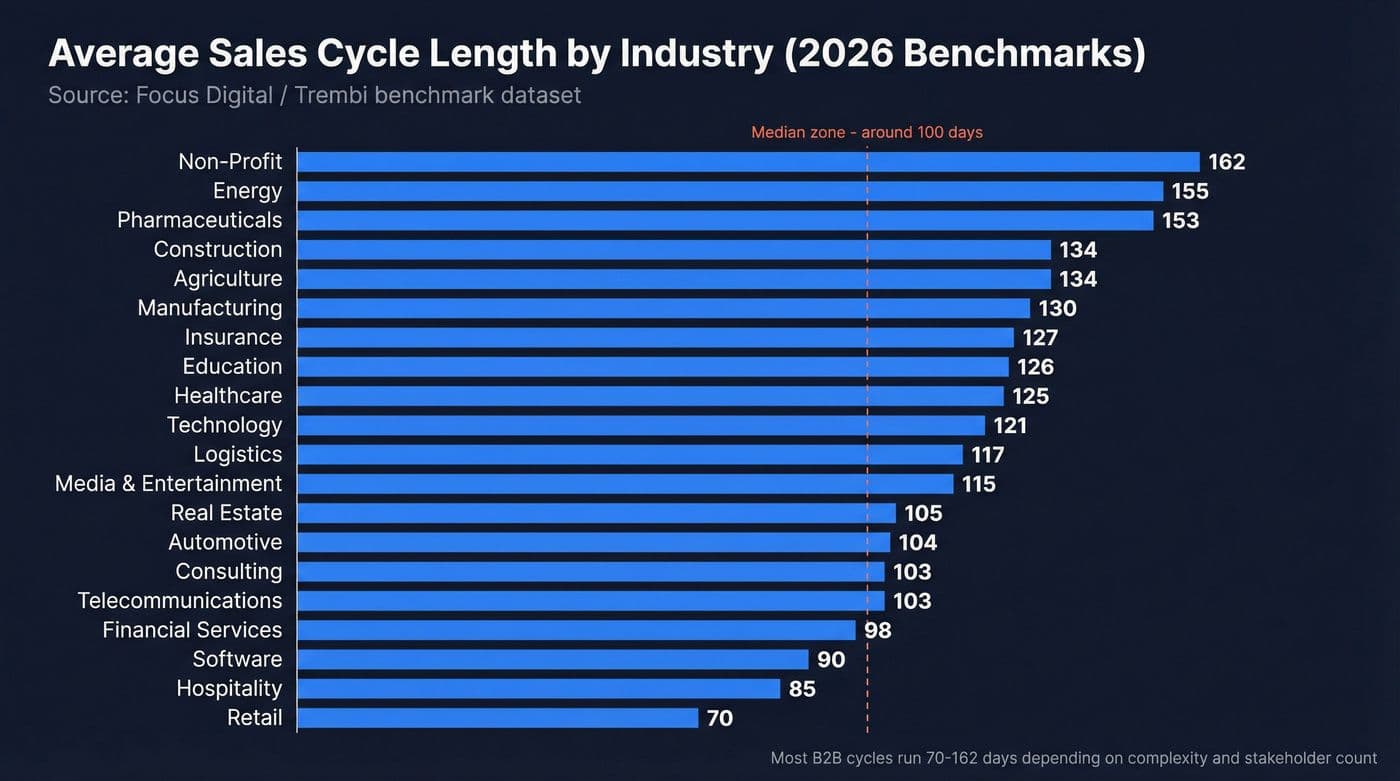
Source: Average Sales Cycle Length by Industry: 2025
Larger deal values mean the cost of a wrong insight is measured in contracts, not cart abandonment. Niche verticals frequently have no published data worth trusting at all, which makes primary research the only defensible option.
The Evolution of B2B Market Research: Trends Driving Change in 2026
The B2B research field in 2026 looks different from five years ago. Most of the change has come from two directions.
First, AI has compressed the timeline for secondary research to near-zero. Any analyst can now pull competitive summaries, market size estimates, and trend reports in a few hours. That shift has actually raised the bar for primary data, not lowered it. When every team has access to the same secondary intelligence — and a documented share of it is built on fabricated market-sizing with no traceable primary source — the structural advantage goes to whoever holds better primary data that competitors can't replicate from a database.
Second, commercial buyers have gotten harder to reach through conventional channels. Response rates to mass email surveys have dropped. Panel quality has deteriorated as incentivized respondents increasingly game responses for reward payouts. The problem is serious enough that we covered it in depth here: When Surveys Lie: The Quiet Data Integrity Crisis No One Is Talking About.
The teams still relying on survey panels for B2B decisions are working with data that is more fragile than it appears. Technology has changed three things in B2B research: how targets get identified, how findings get synthesized, and how fast a full program can move.
Proprietary databases now allow research teams to map specific job titles at specific companies across specific verticals with precision that didn't exist at scale before 2020. That targeting capability directly improves interview quality. The right respondent in the right role produces insight that no general panel can replicate.
AI-assisted synthesis has shortened the distance between raw interview transcripts and structured findings. But the quality ceiling of any synthesis tool is set entirely by the quality of the data going in. Garbage in, garbage out. The distinction that matters most here is not between AI tools and older tools - it's between what AI can do and what a skilled interviewer does. AI takes a response at face value. A trained human researcher recognizes when a respondent is holding back, contradicting themselves, or revealing something indirectly. AI organizes information. Humans extract meaning from it. That gap does not close with better models.

B2B Research Methods for 2026
B2B qualitative research is where real B2B insight lives. It captures the reasoning behind behavior - why a CFO switched vendors, why a buying committee stalled, what problem a procurement director is actually trying to solve rather than the one listed in the RFP.
Qualitative market research services in B2B typically center on in-depth interviews (IDIs) with decision-makers in the target segment. At Bell & Holmes, the format is direct expert outreach: trained Research Consultants reach relevant practitioners through strategic cold outreach, and document findings in a format clients can act on immediately.
Recruiting the right respondents is where most B2B qualitative programs run into trouble. B2B professionals are high-level and low-availability by default. Job titles change quickly, and databases go stale faster than most research teams expect - the person listed as Head of Procurement in a contact tool may have moved roles six months ago. Static panels don't solve this. Only active, targeted outreach, adjusted in real time, gets to the right person at the right moment. Having the right participant in the conversation is at least as important as asking the right questions.
At Bell & Holmes, each respondent's current role, employer, and purchasing scope are confirmed during each interview - independent of the source database - so the conversation doesn't land with someone who moved positions six months ago.
Benefits of Qualitative Research & Example Techniques
In-depth interviews with decision-makers or subject matter experts are the workhorse format. Win/loss research following closed B2B sales cycles gives a sharper picture of competitive positioning than any analyst report. Expert calls with practitioners in a specific vertical or function answer questions that no published source holds.
Buyer persona research - a structured interview program that maps the decision-making process across all stakeholders in a typical purchase - is one of the highest-leverage qualitative investments a B2B team can make. It answers questions that sales and marketing materials frequently get wrong: which persona initiates the long list of potential vendors, which one controls the shortlist, and which one can quietly kill a deal after the final presentation. Jobs-to-be-done research takes a different angle: instead of asking buyers who they are, it asks what outcome they're actually hiring a solution to achieve. Those answers consistently contradict what the product team assumed.
For methodology detail on how direct outreach runs in time-pressured engagements, see: Cold Calling Isn't Dead: Why Outreach Still Wins in Due Diligence.
Quantitative Research Approaches
Quantitative B2B research is useful for sizing, benchmarking, and testing hypotheses that qualitative work has already generated. The standard formats are structured surveys, conjoint analysis for pricing and feature prioritization, and statistical models built from secondary datasets.
The constraint is sample quality. In B2B, 80 confirmed respondents who match the exact buying profile are worth more than 800 who are broadly adjacent. Criteria precision beats raw volume.
Where quantitative B2B surveys add the most value is in ranking and benchmarking work: which buying criteria matter most to a segment, how a brand stacks up against named competitors in buyer perception, how satisfied current customers actually are versus what the renewal rate suggests. Usage and attitude studies - a less commonly run but highly practical quantitative format - investigate how products are used in real operational contexts, often surfacing adoption gaps that pure satisfaction data would miss entirely.
Mixed-method programs combine qualitative discovery with quantitative validation. The sequence matters: qualitative interviews identify the key variables first; quantitative work then tests the distribution of those variables across a larger sample.
The common error is running both in parallel, or worse, running the survey first. A survey tests hypotheses you haven't yet formed. The result is statistically tidy data that doesn't answer the strategic question.
Market Opportunity Assessment
A market opportunity assessment answers one specific question: is there a viable, accessible market for what we're planning to build, enter, or acquire? In a deal context, that question expands into a buyer-seat competitive map built before signing, because TAM math alone never settles it. In B2B, it covers four areas: total addressable market and the serviceable segment within it; competitive density and where whitespace actually exists; customer need intensity and what current solutions are failing to address; and buyer accessibility - how procurement decisions actually get made in this segment.
The mistake most teams make is running this assessment on secondary data alone. Published market sizing reports often lag by 12-18 months and rarely capture the specifics of a niche vertical. Primary research is what closes the gap between the published estimate and market reality — and in commercial due diligence, it is the only method that reliably uncovers the red flags secondary data structurally cannot reveal.
A well-run assessment goes beyond confirming that a market exists. It asks whether the market is growing or contracting and at what rate. It asks whether organizations in the target segment actually have the problem the solution is designed to solve, or whether they already have a workaround, they're comfortable enough to stay with. It asks what budgets they currently set for adjacent solutions - because willingness to pay rarely matches stated preference. And it maps when organizations reach the inflection point where current workarounds stop being sufficient: the moment a need becomes urgent enough to trigger a serious procurement process. Without answers to those questions, a market size figure is a number without context.
Tools and Techniques for Assessment
Proprietary databases and structured outreach are the foundation for market mapping. Expert interviews with practitioners in the segment generate the qualitative signal that tells you whether the need is real, how intense it is, and who the actual decision-maker is. Win/loss research with buyers who recently evaluated multiple vendors produces competitive positioning data that no public source holds.
Bell & Holmes delivers market opportunity assessments in as few as five working days, combining database-driven targeting with trained consultant outreach across 140+ countries and 35+ languages. In a recent agricultural due diligence engagement for a Big 3 consultancy - spanning North America, Europe, and Asia, with native-language coverage across the US, UK, France, Spain, Italy, and India - that meant 30 qualified interviews across three continents, completed inside five days: farm owners, agronomists, and distributor leads, with synthesized findings delivered daily as fieldwork ran.
Most expert networks handle non-English market briefs through translated screeners or bilingual intermediaries - a workaround that narrows the respondent pool and loses the conversational precision that makes an interview worth running.
Leveraging B2B Customer Insights
B2B customer insights answer a different question from general market research. Not "what is the market doing" but "what does this specific buyer type actually need, and what would it take to win their business?" The distinction matters because B2B purchase decisions rarely hinge on product features alone. Organizational politics, risk aversion, incumbent vendor relationships, and internal budget cycles all shape buying behavior - often more than the product's actual merits.
The buying group itself compounds this. According to the Gartner B2B Buying Study the average enterprise B2B buying group consists of five to 11 stakeholders. Each one carries a different frame for evaluating risk and a different definition of what a successful outcome looks like. The CFO asking about total cost of ownership and the IT director asking about integration complexity are technically making the same purchase decision, but they need completely different information to say yes. Research that collapses those perspectives into a single composite "buyer" produces insight that lands for none of them. Effective B2B customer research captures each stakeholder's position separately, then maps how those positions interact when the buying committee meets.
Research teams that treat customer insight as a post-sales function miss the window where it matters most: before the product is built, before the price is set, before the go-to-market motion is locked.
For a European private equity firm evaluating an enterprise data platform - with outreach across North America, Europe, Scandinavia, and Germany, and native-language capability required across both markets - that meant 16 confirmed interviews completed in three working days: heads of data, IT directors, and implementation partners at large enterprises across financial services, healthcare, and retail, with daily client calibration to shift regional emphasis and dig into patterns surfacing from early calls. The scope covered adoption rationale, competitive alternatives, pricing dynamics, deployment models, and switching behavior - the buyer intelligence that shapes an investment thesis before a position is taken. The full engagement is documented in the enterprise data platform customer evaluation.
Direct conversation with current and prospective buyers is the most reliable method. This means structured interviews that leave room for the respondent to surface issues the researcher didn't know to ask about. The best interview data comes from questions the guide didn't anticipate.
Secondary sources - CRM data, product usage logs, support tickets - provide behavioral signals, not motivational ones. They tell you what a customer did. A churned customer shows up in CRM data. Only an interview tells you why they actually left.
Market Segmentation B2B: Effective Segmentation Strategies
B2B segmentation starts with clarity about the unit of analysis: companies or personas within companies? Both matter, but they answer different questions.
Company-level segmentation uses firmographic variables - industry, size, geography, revenue, growth stage. Persona-level segmentation uses role, seniority, functional mandate, and decision-making authority. Behavioral segmentation, which groups buyers by purchasing patterns, technology adoption, or vendor-switching history, is harder to build but usually the most predictive.
For market segmentation B2B programs, primary research is what converts firmographic assumptions into behavioral reality. A vertical that looks uniform in a database often breaks into three or four distinct buying patterns once you've spoken directly to 20-30 practitioners inside it.
Targeted segmentation reduces wasted sales and marketing spend by focusing resources on segments with the highest probability of conversion. It also sharpens product decisions by surfacing segment-specific needs that a one-size approach would miss.
The downstream benefit is pricing power. Segments with well-understood needs and limited vendor alternatives consistently pay more for solutions that speak directly to their operational context.
Future Outlook: Decision-Grade Research Beyond 2026
AI is reshaping how B2B research findings get processed and applied. But it has not replaced the data collection work. Predictive analytics tools can model market trajectories, forecast competitor behavior, and flag segments likely to shift - but every model depends on the quality of the primary data feeding it.
The organizations that will hold an information advantage post-2026 are not the ones with the best AI tools. They're the ones with the highest-quality human-sourced data going into those tools - the core logic behind the human + AI operating model now running at the leading research firms.
There is a cleaner way to put the underlying limitation. AI interpolates: it recombines patterns from data it has already seen. Human researchers extrapolate: they identify possibilities the existing data hasn't named yet because no one has asked the right question of the right person. That's where competitive intelligence tends to actually live - in what a practitioner tells you off-script, in the contradiction between what a buyer says in a survey and what they describe in a conversation, in the detail mentioned almost as an aside that reframes the whole market. A second risk is accelerating in parallel: synthetic respondents. AI-generated personas and simulated survey responses are increasingly being used in research programs as a cost-cutting measure.
Synthetic respondents are built from patterns in data that already exists. They can describe the market as it has been disclosed. Nothing in their construction can surface what's shifting - the workaround a procurement team quietly adopted last quarter, the vendor quietly gaining ground in a segment, the budget trigger that changed after the last survey was fielded. That is precisely why a layer of human-verified interviews now functions as the control group underneath any AI-heavy stack.
Quarterly research cycles are increasingly out of sync with how fast B2B markets move. In fast-moving categories - enterprise SaaS, fintech infrastructure, industrials undergoing automation - conditions can shift materially in 60 days. A research program that delivers findings in 48-72 hours rather than 6 weeks provides a structural advantage in those environments.
Speed is not a premium feature. For strategy teams working against compressed decision windows, it's the baseline requirement. The best insight is only useful if it arrives before the decision is made. For more on why this matters in private markets: Why the Best Private Market Deals Start with Primary Data.

Conclusion
The gap in B2B research in 2026 is not between companies that have data and those that don't. It's between companies whose data holds up under pressure and those whose data falls apart the moment someone asks a hard question.
Decision-grade research requires three things: access to the right respondents, the methods to extract honest answers, and the speed to deliver findings before the window closes. Most research programs are optimized for cost and volume. The ones that actually move decisions are optimized for signal quality.
Bell & Holmes runs primary B2B research programs across 140+ countries and 35+ languages. Every engagement is executed by trained Research Consultants through direct strategic outreach - no panels, no incentivized samples. Delivery in as few as 48 hours for time-critical engagements.
If the next decision requires data you can defend, talk to Bell & Holmes.
Our services
From hypothesis to investment-ready evidence

One operating standard across all levels of depth, and no vendor change when the question gets harder
Where we operate
Traditional Surveys
Survey Intelligence
How it works →Direct Interviews
See the process →Expert Network
Not sure which approach your project needs? We will point you to the ideal one that still answers it.